
California Car Accident Lawyer
Over $30 Million Won for California Clients in 2025 Alone
![[object Object]](/_next/image?url=%2F_next%2Fstatic%2Fmedia%2Fbadge-12.dc462899.png&w=1920&q=75)
![[object Object]](/_next/image?url=%2F_next%2Fstatic%2Fmedia%2Fbadge-1.84d39f5d.png&w=384&q=75)
![[object Object]](/_next/image?url=%2F_next%2Fstatic%2Fmedia%2Fbadge-2.736d1614.png&w=384&q=75)
![[object Object]](/_next/image?url=%2F_next%2Fstatic%2Fmedia%2Fbadge-3.30517db2.png&w=384&q=75)
![[object Object]](/_next/image?url=%2F_next%2Fstatic%2Fmedia%2Fbadge-4.c449d07d.png&w=384&q=75)
![[object Object]](/_next/image?url=%2F_next%2Fstatic%2Fmedia%2Fbadge-5.251e1420.png&w=1080&q=75)
![[object Object]](/_next/image?url=%2F_next%2Fstatic%2Fmedia%2Fbadge-6.e1d85cbc.png&w=384&q=75)
![[object Object]](/_next/image?url=%2F_next%2Fstatic%2Fmedia%2Fbadge-7.3fcf7c05.png&w=384&q=75)
![[object Object]](/_next/image?url=%2F_next%2Fstatic%2Fmedia%2Fbadge-8.3e662d12.png&w=384&q=75)
![[object Object]](/_next/image?url=%2F_next%2Fstatic%2Fmedia%2Fbadge-9.60ef0ba6.png&w=384&q=75)
![[object Object]](/_next/image?url=%2F_next%2Fstatic%2Fmedia%2Freputation-award.3f62935c.png&w=3840&q=75)
A car accident does not end when the collision does. Medical bills arrive before you know the full extent of your injuries. The at-fault driver's insurer calls before you've spoken with an attorney. And the evidence that determines your claim's outcome, such as traffic footage, physical road evidence, and witness accounts, starts disappearing within 72 hours.
California Trial Law Group is a personal injury firm based in Albany, CA, representing car accident victims across the state. Our California car accident lawyer takes over the investigation, handles all insurer communication, builds the evidentiary record needed to support your claim, and manages the legal process from first call through resolution.
Lead attorney Ike M. Kaludi (California State Bar No. 289576) has recovered over $29 million in a single auto accident case and tens of millions more for injured Californians, without charging a dollar upfront.
If we do not recover compensation for you, you owe nothing.
You can also review California Trial Law Group testimonials to see how past clients describe their experience working with the firm, from the support they received during the legal process to the results achieved in serious accident and injury cases.
Call (888) 238-7562 for a free, confidential case evaluation.
Injured in a California Car Accident? Request a Free, Confidential Case Evaluation
There are no upfront fees and no obligation to hire. Call (888) 238-7562 or submit your information online, and an intake team member will review your accident details, injuries, and any insurer contact. Most evaluations are completed the same day.
California Car Accident Case Results: What We Have Recovered
Prior results do not guarantee a similar outcome. Case results depend on the specific facts and legal claims of each matter.
How Does Our Process Work?
California Trial Law Group manages every phase of a car accident claim, from the first call through final payment, at no upfront cost. The process begins within 24 hours of engagement and continues through investigation, negotiation, and, if necessary, trial.
- Free Case Evaluation (within 24 hours): Call (888) 238-7562 or submit your information online. An intake team member reviews your accident details, injuries, and any insurer contact. Most evaluations are completed the same day.
- We Take Over Immediately: Once retained, our California auto accident lawyer sends a representation letter to all insurers, directing them to communicate only with our office. We issue evidence preservation demands to law enforcement, traffic agencies, and relevant businesses within 24 hours of engagement. You stop communicating with any insurer.
- Investigation and Case Building: Our team obtains police reports, traffic footage, witness statements, black box data, and medical records. On catastrophic injury cases, we work with vocational experts, life-care planners, and accident reconstruction specialists to document the full economic impact of your injuries.
- Negotiation or Litigation: We present a comprehensive demand to the at-fault insurer. If a fair offer is not made, we file suit. Every injury case is prepared for trial from day one, the most effective pressure tool against insurers who undervalue claims.
- Resolution and Payment: Settlement or verdict proceeds are distributed after attorney fees and case costs are deducted from the recovery. You receive a complete accounting of every dollar.

What Do Insurance Companies Do After a California Car Collision?
Within hours of a California car accident, the at-fault driver's insurer opens a file and assigns an adjuster whose performance is measured by how little the company pays out. Specific tactics begin before the injured victim has left the hospital.
- Records everything you say. Adjusters call fast, while you are still in shock. A neutral statement like “I didn't see them coming” becomes documented evidence of inattention.
- Track your treatment. Every gap between medical appointments is logged as evidence that your injuries aren't serious. Miss two weeks of physical therapy, and that gap will appear in their denial letter.
- Monitor your social media. A photo from a family dinner, a comment that you're doing better, or anything suggesting normal activity is pulled into their file.
- Search your medical history. A signed medical authorization gives adjusters access to your full treatment history. They comb it for prior back complaints, neck injuries, or pre-existing conditions they can use to argue your current symptoms predated the crash.
- Make a fast, low offer. The first settlement figure is designed to close your case before you know what your injuries will actually cost. Signing it releases the insurer from all future liability, including conditions that worsen or complications that develop months later.
Under California insurance law, insurers are legally prohibited from using deceptive tactics or unreasonably delaying valid claims. When an insurer crosses that line, additional remedies are available to you. Our California personal injury lawyers identify and document bad-faith conduct from day one.
Tell any adjuster who contacts you that your automobile accident attorney will be in touch. Say nothing else.
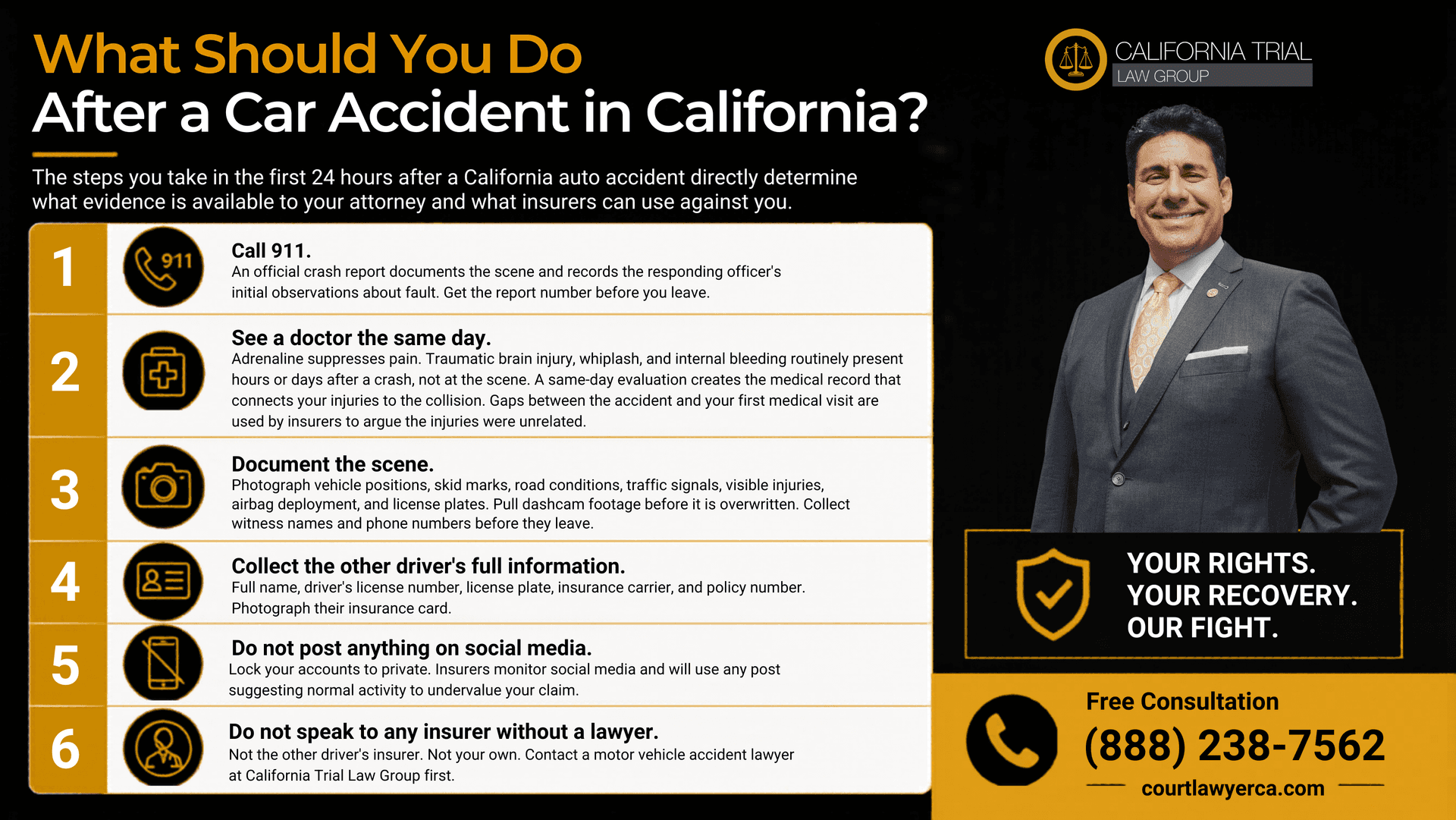
What Should You Do After a Car Accident in California?
The steps you take in the first 24 hours after a California auto accident directly determine what evidence is available to your attorney and what insurers can use against you.
- Call 911. An official crash report documents the scene and records the responding officer's initial observations about fault. Get the report number before you leave.
- See a doctor the same day. Adrenaline suppresses pain. Traumatic brain injury, whiplash, and internal bleeding routinely present hours or days after a crash, not at the scene. A same-day evaluation creates the medical record that connects your injuries to the collision. Gaps between the accident and your first medical visit are used by insurers to argue the injuries were unrelated.
- Document the scene. Photograph vehicle positions, skid marks, road conditions, traffic signals, visible injuries, airbag deployment, and license plates. Pull dashcam footage before it is overwritten. Collect witness names and phone numbers before they leave.
- Collect the other driver's full information. Full name, driver's license number, license plate, insurance carrier, and policy number. Photograph their insurance card.
- Do not post anything on social media. Lock your accounts to private. Insurers monitor social media and will use any post suggesting normal activity to undervalue your claim.
- Do not speak to any insurer without a lawyer. Not the other driver's insurer. Not your own. Contact a motor vehicle accident lawyer at California Trial Law Group first.
What Compensation Can You Recover in a California Car Accident Claim?
California law allows three categories of financial recovery in a car accident claim: economic damages for documented financial losses, non-economic damages for harms without a fixed price, and punitive damages when the at-fault driver acted with gross negligence or intentional misconduct.
Economic damages are calculated from verifiable records and include:
- Emergency care, hospitalization, surgery, and specialist visits
- Ongoing physical therapy, rehabilitation, and medication
- Medical equipment and home modifications required by disability
- Lost wages during recovery
- Reduced future earning capacity if the injury permanently limits the ability to work
- Vehicle repair or replacement
- Future income loss, documented by vocational experts and life-care planners for catastrophic cases
Non-economic damages compensate for harms that do not appear on a bill:
- Physical pain and suffering, past and future
- Emotional distress, anxiety, depression, and PTSD
- Loss of enjoyment of life
- Loss of consortium - the impact of your injuries on your marriage or domestic partnership
Punitive damages are available when the at-fault driver acted with gross negligence or intentional misconduct. DUI crashes are the most common trigger. California courts award punitive damages to punish the defendant and deter similar conduct. These are separate from, and in addition to, compensatory damages.
The full value of a car accident claim includes all three categories. Economic damages form the baseline; non-economic damages frequently exceed them in serious injury cases.
If you want to understand what your case may be worth, call (888) 238-7562 for a free, confidential case evaluation.
What Types of Car Accidents Does California Trial Law Group Represent?
California Trial Law Group represents all categories of motor vehicle collisions in California. Each crash type carries distinct liability rules, evidence requirements, and defense strategies, and our approach is built around those differences.
- Rear-End Collisions: California vehicle codes establish a safe following-distance duty. The trailing driver is presumed liable in most rear-end cases, but defense teams frequently argue the impact was too minor to cause the claimed injuries. We obtain black box data, crush-damage assessments, and biomechanical expert opinions to counter low-impact defenses.
- Head-On Collisions: Head-on crashes are caused by wrong-way driving, center-line crossings, or drivers who fall asleep at the wheel. They produce severe injuries and commonly involve DUI or distracted driving, which we investigate from day one.
- Side-Impact (T-Bone) Collisions: Right-of-way disputes are the central issue at most intersections. We obtain signal timing records, intersection surveillance footage, and witness statements before they are lost.
- Intersection Accidents: Failure to yield, red-light running, and illegal turns create complex multi-party liability questions. We reconstruct the signal cycle, establish vehicle positions, and identify every liable party before demand is sent.
- Speeding Accidents: California’s Basic Speed Law creates liability when a driver travels too fast for conditions, even if they were under the posted limit. We document speed through skid mark analysis, event data recorder output, and traffic-pattern evidence.
- Multi-Vehicle Collisions: Three or more vehicles create layered liability and competing insurer interests. We represent your interests against all parties simultaneously and ensure no defendant avoids responsibility for their share.
- DUI / Impaired Driving Collisions: Drunk or drugged drivers face both criminal prosecution and civil liability. We pursue compensatory damages and, where appropriate, punitive damages and related civil claims under California law.
- Rideshare Accidents (Uber / Lyft): Rideshare companies may provide commercial coverage depending on the driver’s status at the time of the crash. We identify the applicable coverage tier, obtain the driver’s trip log, and pursue the available policy limits.
- Commercial Vehicle and Truck Collisions: Federal Motor Carrier Safety Administration regulations, hours-of-service logs, and commercial maintenance records create additional evidence and liability sources. We use industry experts to establish regulatory violations.
- Fatal Accidents / Wrongful Death: Surviving family members may pursue wrongful death claims for loss of financial support, funeral costs, and loss of companionship under California Code of Civil Procedure § 377.60.
- Autonomous and Self-Driving Vehicle Accidents: California has more autonomous test vehicles on public roads than any other state. When a self-driving system failure, sensor error, or software defect contributes to a crash, liability may extend to the vehicle manufacturer or software developer in addition to the operator. We evaluate all potential defendants in these cases.

Injuries We Handle for California Car Crash Victims
California Trial Law Group represents car accident victims with injuries at every level of severity. The hidden injuries most frequently disputed by insurers and the ones that require the most careful documentation are those that do not appear on an X-ray: whiplash, traumatic brain injury, and psychological trauma. Catastrophic injuries, including spinal cord damage and internal organ injury, require a different legal strategy focused on long-term care costs and permanent disability.
- Whiplash and Soft-Tissue Injuries: Symptoms like neck pain, headache, stiffness, and dizziness often appear 24 to 72 hours after the crash. Insurers use this delay to argue the injury predated the collision.
- Traumatic Brain Injuries: TBIs from a car accident range from a concussion with temporary cognitive disruption to severe TBI with permanent memory loss, speech impairment, or personality change.
- Spinal Cord Injuries: Spine and spinal cord injuries from car accidents range from herniated discs to complete paralysis, frequently requiring surgical intervention followed by years of rehabilitation.
- Internal Organ Damage: Bruised, lacerated, or ruptured organ injuries are often invisible at the crash scene. Without immediate emergency evaluation, blunt-force trauma can cause internal bleeding that quickly becomes life-threatening.
- Broken Bones & Amputations: Fractures vary from minor breaks to complex ones needing surgery and a long recovery. Amputations result in permanent disability impacting work, daily function, and quality of life.
- PTSD and Psychological Injuries: Symptoms like flashbacks, nightmares, severe anxiety, and driving avoidance are documented via psychiatric records. Emotional distress, depression, and anxiety resulting from the accident are recoverable as non-economic damages.
Your injuries and how they are documented directly affect the value of your claim. Contact us to speak with a California car accident attorney about your situation.
California Car Accident Statistics
California recorded 242,649 traffic injuries and 4,539 traffic fatalities in 2022, averaging approximately 665 injuries every day of the year. Due to its high population and vast highway network, California consistently records more traffic-related deaths than almost any other state.
Alameda County remains a major focal point for regional traffic incidents in Northern California. The county recorded over 7,400 injury-producing collisions in 2022. Several high-incident corridors in the East Bay contribute significantly to these totals:
- Interstate 80 (Richmond to the Bay Bridge)
- Interstate 880 (The Nimitz)
- Interstate 580 (Tri-Valley Corridor)
If you were injured on any of these corridors or anywhere else in California, call (888) 238-7562. Our personal injury law firm represents car accident victims statewide.
Serving Clients Across California
California Trial Law Group represents car accident victims statewide, with no requirement to travel to the office. We come to you by video, phone, or hospital visit, wherever in California you are.
Learn More: California Car Accident Resources for Injured Victims

ATTORNEY ADVERTISING: The information on this website is for general informational purposes only and does not constitute legal advice. California Trial Law Group does not form an attorney-client relationship through this website. The attorney listings on the site are attorney advertisements and should not be viewed as a referral or endorsement by any state agency or bar association. No certification as a specialist in any field of law is claimed by the lawyers listed here. Results from one case are not a guarantee of future outcomes, as each case has unique aspects. This website is intended to provide general information; it is up to you to decide if a particular attorney is suitable for your legal needs. You may be responsible for certain costs or expenses in addition to any contingency fee arrangement for attorney's fees. By using this site, you agree to our Terms and Conditions. This site is protected by reCAPTCHA and the Google Privacy Policy and Terms of Service apply.
The contents of this website and any attached or linked materials are intended solely for informational purposes and should not be taken as legal advice for any individual case or situation. Viewing this material does not create an attorney-client relationship. Choosing an attorney is a crucial decision and should not be based solely on advertisements. The outcome of your specific case will depend on its particular facts; previous results do not guarantee a similar outcome. Each case must be evaluated on its own merits. Reports of past cases on this website are not intended to generate unjustified expectations about any future case you might have.
California Trial Law Group is dedicated to defending the rights of the elderly in nursing home abuse cases. Our website offers general information and directs you to contact us for personalized legal advice tailored to the specifics of your situation. No attorney-client relationship is established by your use of this site or by any communication initiated through this website's contact forms. California Trial Law Group © 2026. All Rights Reserved.