California Distracted Driving Accident Attorney
Over $30 Million Won for California Clients in 2025 Alone
![[object Object]](/_next/image?url=%2F_next%2Fstatic%2Fmedia%2Fbadge-12.dc462899.png&w=1920&q=75)
![[object Object]](/_next/image?url=%2F_next%2Fstatic%2Fmedia%2Fbadge-1.84d39f5d.png&w=384&q=75)
![[object Object]](/_next/image?url=%2F_next%2Fstatic%2Fmedia%2Fbadge-2.736d1614.png&w=384&q=75)
![[object Object]](/_next/image?url=%2F_next%2Fstatic%2Fmedia%2Fbadge-3.30517db2.png&w=384&q=75)
![[object Object]](/_next/image?url=%2F_next%2Fstatic%2Fmedia%2Fbadge-4.c449d07d.png&w=384&q=75)
![[object Object]](/_next/image?url=%2F_next%2Fstatic%2Fmedia%2Fbadge-5.251e1420.png&w=1080&q=75)
![[object Object]](/_next/image?url=%2F_next%2Fstatic%2Fmedia%2Fbadge-6.e1d85cbc.png&w=384&q=75)
![[object Object]](/_next/image?url=%2F_next%2Fstatic%2Fmedia%2Fbadge-7.3fcf7c05.png&w=384&q=75)
![[object Object]](/_next/image?url=%2F_next%2Fstatic%2Fmedia%2Fbadge-8.3e662d12.png&w=384&q=75)
![[object Object]](/_next/image?url=%2F_next%2Fstatic%2Fmedia%2Fbadge-9.60ef0ba6.png&w=384&q=75)
![[object Object]](/_next/image?url=%2F_next%2Fstatic%2Fmedia%2Freputation-award.3f62935c.png&w=3840&q=75)
Thousands of injury crashes happen every year in California because a driver looked away, picked up a phone, or stopped paying attention to the road. If a distracted driver caused your accident, you have legal options, and the evidence that proves your case starts disappearing immediately.
At California Trial Law Group, our California distracted driving accident attorney treats every case as a top priority. We move quickly to preserve the evidence that matters most in these negligent car accident claims: the at-fault driver's phone records, eyewitness accounts, traffic camera footage, and surveillance video from nearby businesses. Our principal attorney, Ike M. Kaludi, has helped accident victims recover substantial settlements and verdicts, including a $29.7 million catastrophic motor vehicle accident jury award.
We work on contingency, meaning no fees unless you win, and are available 24/7. For a free, confidential case evaluation, call us at (888) 238-7562 or send a message through our contact form.
Bilingual support is available in English and Spanish.
- • Verified Results of $4,750,000 recovered in a rear-end car accident involving cervical, lumbar, and lower-extremity radiculopathy.
- • Super Lawyers Recipient: 2024–2026
- • Rising Stars Recipient: 2016–2023
- • Named one of the Top Attorneys of North America
- • Selected as one of the best attorneys by SFGate
- • 4.7 Stars on Google from verified clients across California
- • Contingency Fee Guarantee: You pay no attorney fees unless we win
- • Bilingual Support: Serving clients in English and Spanish
The California Trial Law Group Advantage
Past results do not guarantee future outcomes. Results vary based on the specific facts of each case.
What Counts as Distracted Driving Under California Law?
California law treats distracted driving as a serious safety violation. Under California Vehicle Code §23123.5, drivers are prohibited from holding or using a handheld phone while operating a vehicle.
Recent court interpretations clarify that the prohibition applies broadly. Even passive viewing of a handheld device while driving may violate the statute.
Distracted driving generally falls into three categories:
- Manual: Hands off the wheel (eating, grooming, or reaching for objects).
- Visual: Eyes off the road (rubbernecking or checking navigation).
- Cognitive: Mind off the task (daydreaming or phone conversations).
Any activity that takes attention away from driving can increase the risk of a serious collision and injuries. These injuries can range from minor whiplash to catastrophic conditions, such as traumatic brain injuries, spinal cord damage, cervical injuries, fractures, internal organ damage, and psychological conditions.
Schedule a free consultation with our experienced car accident lawyer.
Common Causes of Distracted Driving Crashes in California
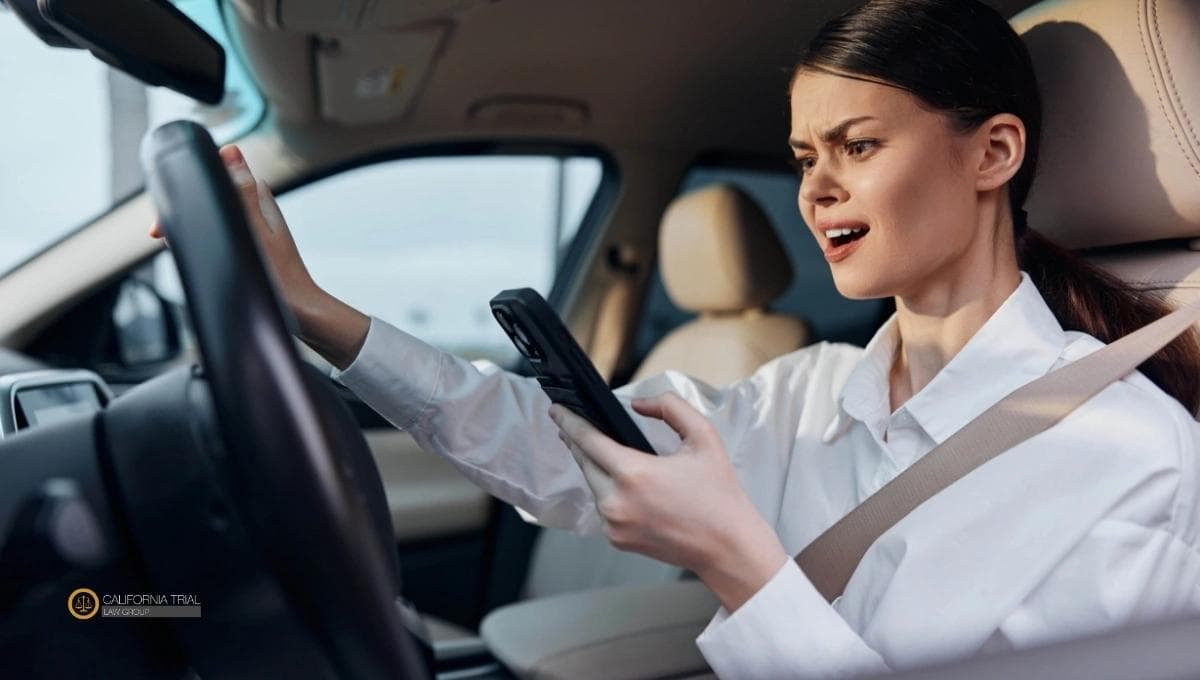
Although texting receives the most attention, distraction takes many forms on California roads.
Common causes of distracted driving crashes include:
| Distraction Type | Example |
|---|---|
| Texting while driving | Reading or sending messages |
| Handheld phone calls | Calling without hands-free use |
| GPS navigation | Entering destinations while moving |
| Infotainment systems | Adjusting apps, music, or climate controls |
| Eating or drinking | Handling food or beverages |
| Grooming | Applying makeup or combing hair |
| Passenger distraction | Turning toward the backseat passengers |
| Reaching for objects | Items on the floor or back seat |
According to the 2025 SafeTREC Traffic Safety Facts, 158 people were killed in distracted-driving crashes in California in 2023, representing about 4% of all traffic fatalities in the state that year.
Busy commuter corridors such as I-80, I-580, I-880, US-101, and Interstate 5 often experience elevated risk because stop-and-go traffic can create a false sense of safety when drivers divert their attention.
If you were injured on any of these corridors or anywhere in California, speak to our California personal injury attorney and learn what compensation may be available to you.
How Do You Prove a Driver Was Distracted at the Time of the Crash?
Proving distraction is one of the most difficult parts of these cases. Drivers rarely admit they were looking at a phone or otherwise distracted when a crash occurred, and insurance companies are aware of this and often challenge these claims without strong evidence.
Evidence that may help establish distraction includes:
- Police reports: Law enforcement officers may document suspected distraction or phone use at the scene.
- Cell phone records: Phone carriers can provide logs showing calls, texts, or data activity around the time of the crash.
- Social media activity near the crash time. Posts, check-ins, stories, or live-stream activity from the at-fault driver's accounts in the minutes surrounding the crash.
- Traffic or surveillance camera footage: Intersections, businesses, and highway cameras sometimes capture driver behavior immediately before impact.
- Witness statements: Other drivers or pedestrians may have observed the at-fault driver holding a phone or looking away from the road.
- Vehicle event data recorder (EDR): Modern vehicles often record speed, braking, and steering inputs before a crash.
- Accident reconstruction: Forensic analysis can show whether a driver failed to react in time, which may support a distraction theory.
Because some digital records are stored only briefly, evidence preservation often becomes one of the first steps in an investigation.
Who Else Can Be Held Liable in a California Distracted Driving Crash?
The at-fault distracted driver is usually the primary defendant. A violation of California Vehicle Code § 23123 or § 23123.5 can be used as evidence of negligence under California Evidence Code § 669, which is the most direct path to establishing fault. But other parties may also share legal responsibility, and identifying every liable party early can significantly affect the compensation available to you.
- Drivers under 18. California Vehicle Code § 23124 prohibits drivers under 18 from using any wireless phone or electronic communication device while driving, even hands-free, except in emergencies. A violation by a minor driver strongly supports a negligence finding.
- Employers. If the at-fault driver was working at the time of the crash, such as a delivery driver, rideshare driver, or sales representative on a work call, the employer may be liable under California's respondeat superior doctrine.
- Vehicle owners. Under California Vehicle Code § 17150, a vehicle owner may be financially responsible for injuries caused by someone driving their vehicle with permission, even if the owner was not behind the wheel.
- Government entities. In limited situations, a city, county, or state agency may share responsibility if unsafe road design or inoperative traffic controls contributed to the crash. These claims follow special notice rules, including the six-month government-claim deadline.
What Compensation Can You Recover After a Distracted Driving Accident?
A distracted driving claim in California can produce compensation across three categories. Which ones apply depends on the severity of the injury, the strength of the evidence, and the conduct of the at-fault driver. At California Trial Law Group, every case is documented from day one with the full damages picture in mind. For permanent or disabling injuries, we bring in vocational experts and life care planners to establish what the injury will cost over a lifetime, not just through the next treatment.
Economic damages cover measurable financial losses supported by records and expert analysis:
- Medical expenses (past and future), emergency care, hospitalization, surgery, specialist consultations, physical therapy, prescription medications, and assistive equipment.
- Lost wages during recovery and reduced earning capacity when the injury limits the ability to return to prior work.
- Property damage to the vehicle and personal belongings.
- Future rehabilitation costs, in-home care, and vehicle modifications where the injury requires them.
Non-economic damages address the personal cost of the injury that no receipt can capture:
- Physical pain and suffering throughout recovery and beyond.
- Emotional distress, mental anguish, PTSD, anxiety, and depression.
- Diminished quality of life and the loss of activities and relationships that the injury disrupted.
- Loss of consortium, covering the impact on a spouse's or family member's relationship with the injured party.
Punitive damages may also be available under California Civil Code § 3294 when the defendant's conduct was malicious, oppressive, or showed conscious disregard for others. A driver texting at freeway speed, or one with prior documented distraction violations, presents the kind of conduct that warrants punitive analysis. These damages are not available in every case, but when the facts support them, they can substantially increase the total recovery.
Not sure which categories apply to your situation? A free, confidential case evaluation costs nothing and gives you a clear picture of where you stand.
What to Do After a Distracted Driving Accident in California
The steps you take in the hours after a distracted driving crash affect both your recovery and the strength of your legal claim. Distracted driving cases in particular depend on evidence that starts disappearing the moment the crash happens. Knowing what to do after an accident can protect your rights and ensure your claim is supported by strong evidence.
- Call 911 and tell the responding officer what you observed. A police report creates an official record of the incident. If you saw the other driver looking down, holding a phone, or not braking before impact, say that clearly to the officer at the scene.
- Get medical attention the same day, even if you feel fine. Soft tissue injuries, concussions, and spinal damage often surface hours or days later. A gap in treatment gives the insurer an argument that your injuries were not serious or not caused by the crash.
- Document the scene before anything is moved. Photograph both vehicles, skid marks, road conditions, and traffic signals.
- Collect witness information immediately. Get names and phone numbers from anyone who stopped or was nearby.
- Decline all recorded statements to the other driver's insurer. The opposing insurance company may call within hours. Avoid admitting fault or apologizing.
- Call a car accident attorney at California Trial Law Group. We move immediately to preserve the evidence that proves the driver was distracted, before carriers delete logs and businesses overwrite footage.
Note: If you were injured but the police did not arrive or did not file a report, document everything yourself and file a collision report with the California DMV (form SR-1) within 10 days if the accident caused injury or death, or property damage over $1,000.
What Does California Trial Law Group Do for Your Distracted Driving Case?
From the first consultation, our firm focuses on the evidence and legal issues that often determine the strength of a distracted driving case.
Our distracted driving legal team may:
- Send evidence preservation letters within 24 hours of engagement. Phone carriers retain call and data logs for months, but business surveillance footage is often overwritten within 30 to 72 hours. We act on the same day we are retained.
- Request the at-fault driver's phone records through formal legal channels. Call logs, texts, and data activity in the minutes before a crash are among the most direct evidence of distraction. The process begins at intake.
- Partner with experts for accident reconstruction. Specialists help link device usage directly to the crash mechanics to establish causation.
- Identify all potentially responsible parties, including employers and vehicle owners.
- Calculate the full scope of damages, including future care costs, lost earning capacity, and non-economic losses that no receipt can capture.
- Handle all insurance communications. You do not speak to any adjuster without legal counsel.
- Prepare the case for litigation from day one, not as a last resort when settlement fails.
While many claims resolve through settlement discussions, preparation for litigation can be an important factor when insurers evaluate a case.
Call (888) 238-7562 for a free case evaluation.
Serving Car Accident Victims Across California
California Trial Law Group represents distracted driving accident victims throughout California from our headquarters in Albany, California.
Ciudades de California donde prestamos servicios como abogados especializados en accidentes de tráfico.
Nuestros abogados se encargan de casos de accidentes automovilísticos en todo California, brindando asesoría legal directamente a su comunidad.
If your injuries prevent you from traveling, consultations are available by phone or video call at no cost.
Get a Free Case Review With a California Distracted Driving Accident Lawyer
Evidence from distracted driving crashes disappears fast. Phone records are not kept indefinitely. Surveillance footage gets overwritten within days. The insurer representing the other driver is already working on the case. Every day without legal representation is a day that benefits them, not you.
Call us or request a free case review online. There is no obligation, no upfront cost, and no attorney fee unless we recover compensation for you, as outlined in a written fee agreement.
ATTORNEY ADVERTISING: The information on this website is for general informational purposes only and does not constitute legal advice. California Trial Law Group does not form an attorney-client relationship through this website. The attorney listings on the site are attorney advertisements and should not be viewed as a referral or endorsement by any state agency or bar association. No certification as a specialist in any field of law is claimed by the lawyers listed here. Results from one case are not a guarantee of future outcomes, as each case has unique aspects. This website is intended to provide general information; it is up to you to decide if a particular attorney is suitable for your legal needs. You may be responsible for certain costs or expenses in addition to any contingency fee arrangement for attorney's fees. By using this site, you agree to our Terms and Conditions. This site is protected by reCAPTCHA and the Google Privacy Policy and Terms of Service apply.
The contents of this website and any attached or linked materials are intended solely for informational purposes and should not be taken as legal advice for any individual case or situation. Viewing this material does not create an attorney-client relationship. Choosing an attorney is a crucial decision and should not be based solely on advertisements. The outcome of your specific case will depend on its particular facts; previous results do not guarantee a similar outcome. Each case must be evaluated on its own merits. Reports of past cases on this website are not intended to generate unjustified expectations about any future case you might have.
California Trial Law Group is dedicated to defending the rights of the elderly in nursing home abuse cases. Our website offers general information and directs you to contact us for personalized legal advice tailored to the specifics of your situation. No attorney-client relationship is established by your use of this site or by any communication initiated through this website's contact forms. California Trial Law Group © 2026. All Rights Reserved.