Your leased car is gone, and the calls start immediately: a tow yard, an adjuster, a leasing company still expecting its payment on the first of the month. Nobody explains what happens if you total a leased car in California before the bills arrive.
California requires insurers to apply a specific calculation, the Total Loss Formula, before declaring your leased car a total loss, not a fixed damage percentage like most states use. Total loss claims hit a record 23.1% of all auto insurance claims nationally in 2025, according to CCC Intelligent Solutions' 2026 Crash Course Report, published March 31, 2026.
What you owe next comes down to three facts: who receives the payout, whether GAP insurance covers the gap, and what you still owe while the claim stays open. Our California car accident lawyers untangle exactly which of the three applies to your situation and know precisely what steps to take next, and in what order.
The table below summarizes what happens and what it means for you before the full breakdown.
| What Happens | What It Means for You |
|---|---|
| Your leasing company owns the car | Your insurer pays them the actual cash value, not you |
| The payout may be less than your lease balance | GAP insurance covers that difference, if you have it |
| The crash was not your fault | You can pursue the gap from the at-fault driver's insurer instead). |
| California uses a specific total loss formula | Repair cost plus salvage value decides the outcome, not a flat percentage |
| Your lease is still active during the claim | You keep making payments until the account closes |
| Your down payment already reduced your monthly bill | GAP coverage does not refund it if the car is totaled |
Your leasing company owns your leased car, and your insurer pays the leasing company the vehicle's actual cash value directly, not you, once your car is declared a total loss. The leasing company holds the title. The insurance settlement goes to the title holder first.
Actual cash value means the vehicle's fair market value immediately before the crash, according to the California Department of Insurance's definition of automobile insurance terms. That figure accounts for age, mileage, and condition, and it lands well below two numbers drivers often expect: the amount originally financed into the lease, and the payoff figure the leasing company quotes over the phone.
Founding attorney Ike M. Kaludi has represented California drivers in these disputes since 2013, and knows how leasing companies and insurers handle a totaled-lease claim differently from an owned-vehicle claim.
A totaled leased car still requires the same first steps as any California crash, plus two calls specific to a lease: notify your insurer and contact your leasing company within the timeframe your lease requires.
For the complete walkthrough of what to do in the minutes and hours after any collision, the full steps to take after any California crash cover documentation, medical care, and how to talk to an adjuster without hurting your claim. Rear-end collisions are a common way a leased vehicle ends up totaled in California, according to California Highway Patrol collision data. If a rear-end collision totaled your leased car, the trailing driver carries a legal presumption of fault that shapes who pays for it.
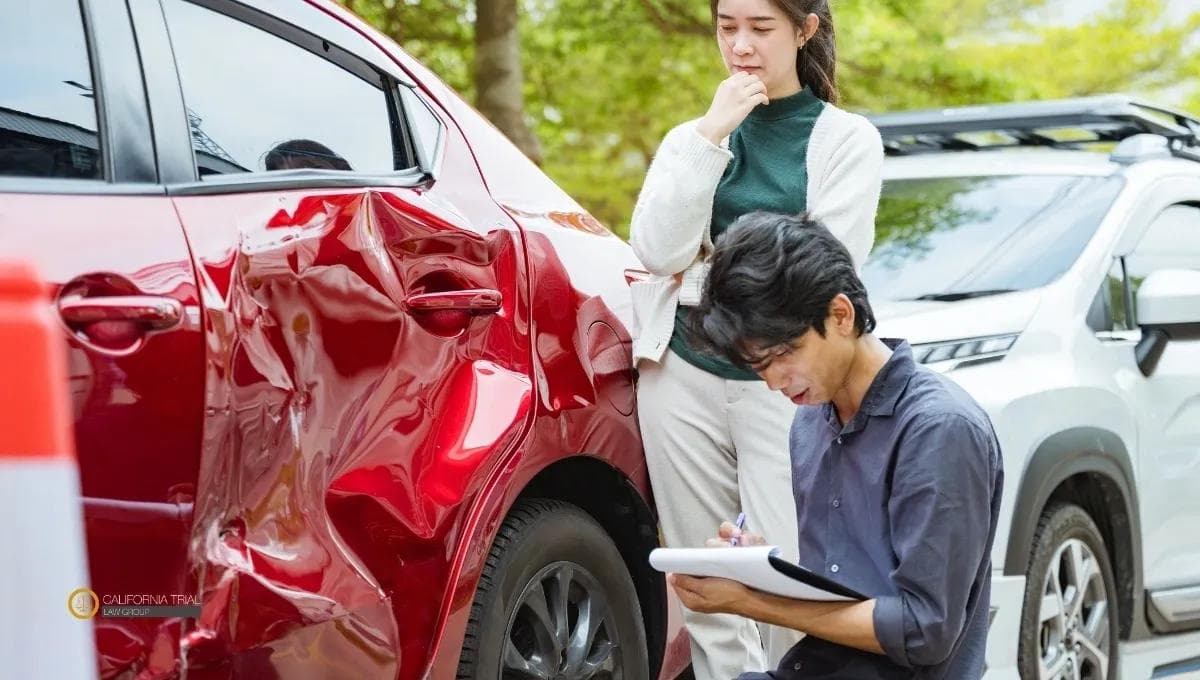
California defines total loss through a specific calculation, not a fixed percentage of damage. Your car is declared a total loss when the cost of repairs, plus the vehicle's salvage value, equals or exceeds its actual cash value.
Most states set a flat damage threshold, often 70 percent or more of a vehicle's value. California requires insurers to apply this formula instead, comparing three numbers: the repair estimate, the salvage value, and the actual cash value. Once your insurer makes that determination, the California DMV issues a Salvage Certificate in place of your leasing company's title, and the vehicle cannot return to the road without a separate inspection.
Two cars with identical damage can have different outcomes in California under this formula, depending on their pre-crash value and how much their wrecked frame or parts are still worth.
Yes. GAP insurance pays the difference between your insurer's actual cash value payout and the remaining balance on your lease, up to your policy's limit. GAP coverage only applies alongside comprehensive or collision coverage, since GAP pays what is left after those coverages pay the vehicle's actual cash value first.
Consider a leased car with a $22,000 remaining lease balance at the time of the crash. Your insurer's actual cash value payout comes in at $18,000. Without GAP coverage, you owe the leasing company the remaining $4,000 out of pocket. With GAP coverage, your GAP policy pays that $4,000 balance, minus any deductible your policy specifies.
California requires lease contracts to disclose whether GAP protection is built in and to state plainly when a lease leaves you liable for the gap amount. Review your lease agreement's GAP disclosure section before assuming the coverage is automatic. Many California leases include it. Not every one does.
If your insurer's total loss offer leaves a gap larger than your GAP policy covers, call us at (888) 238-7562 and we will look at the numbers with you before you accept anything.
Fault does not change who receives the initial insurance payout, but it changes who ultimately pays for the loss. If another driver caused the crash, you can recover the GAP amount and other out-of-pocket costs from the at-fault driver's insurer instead of absorbing them yourself.
I had no idea what to do next.
“I was in a bad car accident on San Pablo Dam Road when another driver lost control in the rain and hit me. The airbags went off, my van was totaled, and I walked away with pain from my neck down to my tailbone, headaches, and a hurt knee. I had no idea what to do next , I just knew I couldn't work and I was scared. My chiropractor recommended California Trial Law Group, and I'm so glad he did. Everything was explained to me in Spanish, which meant the world to me and to my family. They handled all the back and forth with the insurance company so I could focus on healing. Ike Kaludi personally fought hard for my case and never gave up, even when the other side tried to lowball us. It took time, but they got me a result I'm really happy with. I hope nobody else has to go through what I went through, but if you do, these are the people you want in your corner. Thank you, California Trial Law Group."
— Diana De la Cruz · Google Review
Attorney Advertising. Results may vary. 100s Of Cases Won refers to favorable outcomes in settlements, trials, or arbitration.
Diana's van was not leased, but her situation shows the same first fear every totaled-vehicle driver faces: not knowing what happens next while the bills keep arriving.
That fear does not change what California law lets you recover. California follows a pure comparative negligence rule established in Li v. Yellow Cab Co. (1975) 13 Cal.3d 804, which reinterpreted Civil Code §1714, so partial fault reduces your recovery rather than eliminating it. How comparative negligence affects your recovery depends on the percentage of fault a claims adjuster or jury assigns to each driver.
When three or more vehicles collide in sequence, fault gets harder to untangle in a chain-reaction crash, and more than one driver's insurer may dispute the assigned percentage. If the at-fault driver fled the scene, uninsured motorist coverage may apply once a police report documents physical contact between the vehicles, since California requires that contact to support a hit-and-run UM claim.
Your lease payments continue during the claims process. You remain contractually obligated to make your regular lease payment until your insurer, GAP provider, or you personally close out the remaining balance with the leasing company.
Missing a payment while your claim is open can still trigger a late fee or a mark on your credit report, even though the car sits in a tow yard. Once the settlement posts and the account closes, your payment obligation ends.
Your lease agreement may still apply separate charges the total loss settlement does not cover: an early termination fee, an excess mileage charge based on your last recorded odometer reading, or a disposition fee written into the original contract. Request a final account statement from your leasing company to confirm which of these apply before you consider the matter closed.
A totaled lease with a gap between what your insurer pays and what you owe is a common outcome, not a rare one. If your insurer's total loss offer feels low, or the leasing company's final bill does not match your lease terms, founding attorney Ike M. Kaludi and our expert California personal injury lawyers can review the numbers with you at no cost and provide access to useful car accident resources.
Call us at (888) 238-7562, or contact us online if you would rather not call.
Read what to ask a car accident lawyer in California first to know what a good consultation covers.
Attorney Advertising. Results may vary. 100s Of Cases Won refers to favorable outcomes in settlements, trials, or arbitration.
Yes, you still make lease payments after your car is totaled until your insurer's settlement, your GAP coverage, or your own payment closes the account balance with the leasing company. Payments already due before the crash remain your responsibility regardless of the total loss determination.
It depends on whether your leased car's actual cash value exceeds your remaining lease balance when it is totaled. Any money back goes first to the leasing company, and whether you receive some afterward depends entirely on your lease contract's specific terms.
No, you do not get your down payment back if your leased car is totaled. GAP coverage does not reimburse a down payment, according to the Federal Reserve's consumer leasing guide. Your down payment lowered your monthly payments at signing, and a total loss does not return that money.
The leasing company gets paid first if the accident wasn't your fault, because they own the vehicle regardless of who caused the crash. Our guide on what to do after a hit-and-run covers how you recover the difference, not who receives the first check.
You still owe the difference between your payout and your lease balance if you don't have GAP insurance, and that balance does not disappear. Contact your leasing company directly to request a payment plan, since most lessors would rather structure payments than send the account to collections.
California insurers must accept or deny your total loss claim within 40 days of receiving your proof of loss, under the state's Fair Claims Settlement Practices Regulations. Once you accept a settlement, insurers have 30 more days to issue payment, so a straightforward claim settles within 8 to 10 weeks.
Yes, you can get a new lease right away after a total loss once your account with the previous leasing company closes with a zero balance. Your claim resolves according to California's crash-reporting and filing deadlines, and a lender reviews your credit and obligations before approving a new lease.

![[object Object]](/_next/image?url=%2F_next%2Fstatic%2Fmedia%2Fbadge-12.dc462899.png&w=1920&q=75)
![[object Object]](/_next/image?url=%2F_next%2Fstatic%2Fmedia%2Fbadge-1.84d39f5d.png&w=384&q=75)
![[object Object]](/_next/image?url=%2F_next%2Fstatic%2Fmedia%2Fbadge-3.30517db2.png&w=384&q=75)
![[object Object]](/_next/image?url=%2F_next%2Fstatic%2Fmedia%2Fbadge-4.c449d07d.png&w=384&q=75)
![[object Object]](/_next/image?url=%2F_next%2Fstatic%2Fmedia%2Fbadge-5.251e1420.png&w=1080&q=75)
![[object Object]](/_next/image?url=%2F_next%2Fstatic%2Fmedia%2Fbadge-6.e1d85cbc.png&w=384&q=75)
![[object Object]](/_next/image?url=%2F_next%2Fstatic%2Fmedia%2Fbadge-7.3fcf7c05.png&w=384&q=75)
![[object Object]](/_next/image?url=%2F_next%2Fstatic%2Fmedia%2Fbadge-8.3e662d12.png&w=384&q=75)
![[object Object]](/_next/image?url=%2F_next%2Fstatic%2Fmedia%2Fbadge-9.60ef0ba6.png&w=384&q=75)
![[object Object]](/_next/image?url=%2F_next%2Fstatic%2Fmedia%2Freputation-award.3f62935c.png&w=3840&q=75)
![[object Object]](/_next/image?url=%2F_next%2Fstatic%2Fmedia%2Fbadge-11.9de1d49a.png&w=1920&q=75)
![[object Object]](/_next/image?url=%2F_next%2Fstatic%2Fmedia%2Fbadge-13.de4d644c.png&w=640&q=75)