Your car is dented, your neck already hurts, and the other driver is already blaming you for a crash you did not cause. California recorded 4,061 traffic deaths in 2023, an average of 11 people every day, according to the California Office of Traffic Safety's statewide Quick Stats (OTS, updated July 2025). Determining fault by location of damage after a car accident starts with where your vehicle was hit, since front, rear, and side damage each point an insurance adjuster toward a different driver before anyone reads a police report.
Our California car accident lawyers read that damage pattern the way an adjuster does, then build the medical and physical evidence your claim needs before the insurer settles the story on their terms.
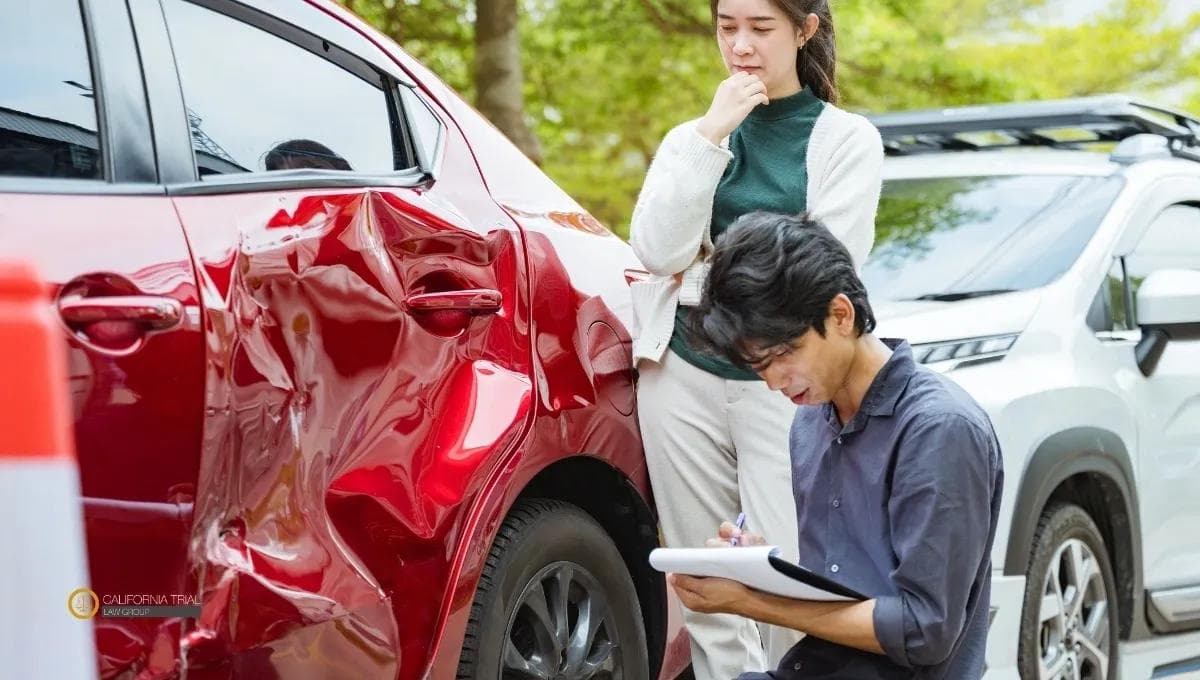
The location of damage on your vehicle, front, rear, or side, shows the direction and angle of impact, which helps investigators and insurers reconstruct how a California car or California semi-truck accident happened and who caused it. Insurance adjusters, police officers, and accident reconstruction experts all start with the same physical evidence: where the vehicles first made contact and how far the damage spreads.
The table below shows how California insurers typically read four common damage patterns.
| Damage Location | What It Often Indicates |
|---|---|
| Front bumper, hood | The driver moving forward struck something ahead, often a stopped or slowing vehicle |
| Rear bumper, trunk | A trailing vehicle failed to stop in time or followed too closely |
| Driver or passenger door | A right-of-way violation at an intersection or driveway |
| Front corner, diagonal crush | A turning vehicle met through traffic at an angle |
Damage location narrows the possibilities. It does not settle the claim on its own. Talk to our seasoned legal team at CTLG before you accept an insurer's read of your photos alone.
California follows pure comparative negligence, so a court can find you partly at fault based on damage evidence and still let you recover compensation, reduced by your percentage of fault. The California Supreme Court adopted this rule in Li v. Yellow Cab Co. (1975), and California Civil Code Section 1714 sets the underlying duty of care that every negligence claim, including a car accident claim, rests on. Insurers use crush patterns and point of impact to argue you contributed to the crash, even when the other driver clearly ran a red light or rear-ended you.
Section 1714 is also what lets a jury or adjuster divide fault by percentage instead of assigning it entirely to one driver.
The table below shows how a fault percentage changes what you recover on a $100,000 claim.
| Credential Type | Total Damages | What You Recover |
|---|---|---|
| 0% | $100,000 | $100,000 |
| 25% | $100,000 | $75,000 |
| 30% | $100,000 | $70,000 |
| 50% | $100,000 | $50,000 |
| 90% | $100,000 | $10,000 |
A 25 percent share of fault reduces your payout by 25 percent. It does not erase your claim. Under California's pure comparative negligence rule, a driver found 90 percent at fault still recovers 10 percent of documented losses.
Even if you share part of the fault for a California crash, comparative negligence does not close your claim. Call us at (888) 238-7562, and we'll tell you what your fault percentage does to your recovery before you accept an adjuster's number.
Rear-end damage almost always points to the trailing driver, since California Vehicle Code Section 21703 requires drivers to leave enough space to stop safely behind the vehicle ahead of them. A crushed trunk or bent rear bumper on your car, paired with front-end damage on the other vehicle, is a reliable fault pattern in California car accident claims, since it lines up directly with that following-distance duty.
The trailing driver who fails to stop in time breaches the following-distance duty under Vehicle Code Section 21703. That breach is usually enough for an adjuster to assign primary fault.
Exceptions exist. A lead driver with broken brake lights or a sudden, unnecessary stop can shift part of the fault back. Our attorneys review dashcam footage and repair estimates to confirm who is at fault in a rear-end collision before an insurer locks in a lowball number.
A rear-end freeway collision left one of our clients with cervical, lumbar, and lower-extremity radiculopathy. The defendant admitted fault at the scene. Liability stopped being the fight, and the value of the injuries became the case. Our attorneys secured a $15,000,000 settlement, the firm's largest published rear-end recovery. That figure reflects the radiculopathy diagnosis, not the size of the dent in the bumper.
Photographs of a crushed trunk tell an adjuster where the impact happened. They do not tell a jury what nerve damage costs a person for the next 40 years.
Attorney Advertising. Results may vary. 100s Of Cases Won refers to favorable outcomes in settlements, trials, or arbitration
Our California rear-end accident lawyers walk through the following-distance rules that apply to your specific crash.
Side-impact damage on your door or rear quarter panel usually means another driver failed to yield the right-of-way, while front-end damage on their car confirms they were the one moving into your path. T-bone crashes happen most often at intersections, where one driver runs a red light, misses a stop sign, or turns without checking oncoming traffic. The vehicle struck on the side rarely caused the collision; the vehicle that struck it usually did.
Right-of-way disputes at unsignaled intersections complicate this pattern. California traffic law gives priority to the driver who arrives first, or the driver on the right when two vehicles reach a four-way stop at close to the same time. Signal timing records and intersection camera footage settle these disputes when the damage alone leaves the sequence unclear.
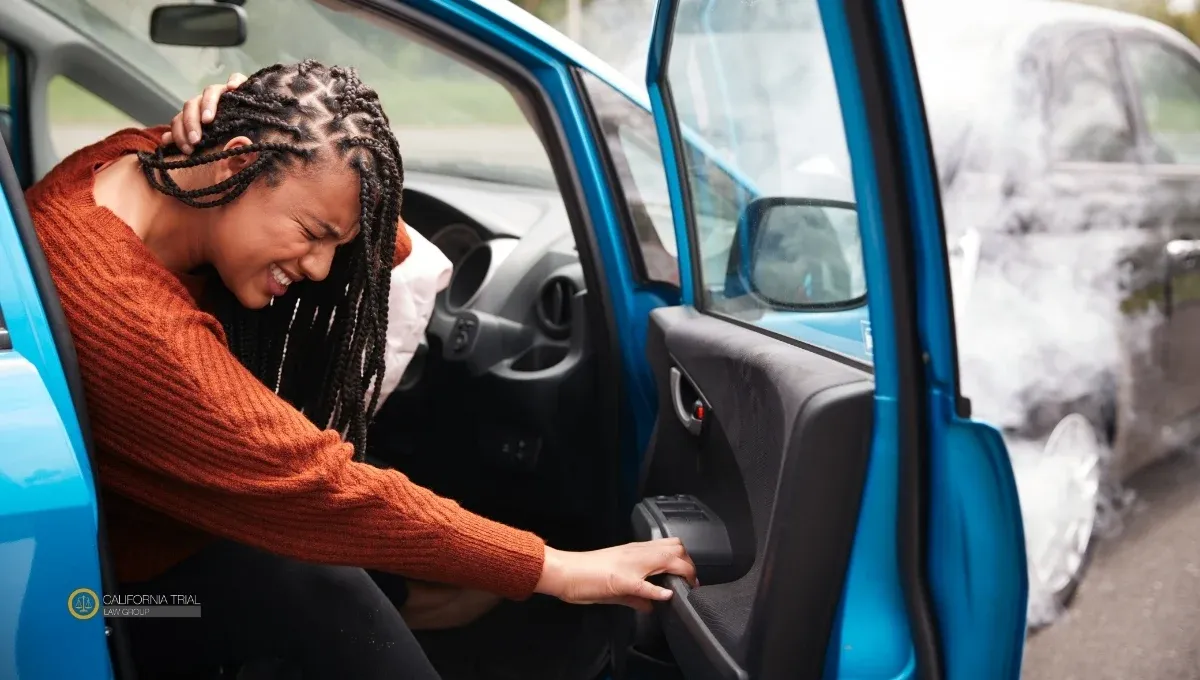
Scrape marks along the side of your car point to a sideswipe, and the driver who crossed into an occupied lane without checking their blind spot is usually the one found at fault. Both vehicles often show similar scrapes in a sideswipe, so location alone rarely proves which driver drifted first.
Paint transfer direction, mirror damage, and the exact position of the scrape relative to each vehicle's lane line narrow down who crossed the line. A driver who speeds up while another car merges shares part of the fault even if the merging driver made the first move. Witness accounts and lane-marking photos carry more weight in a California sideswipe claim than in almost any other crash type.
A left-turning driver who strikes an oncoming car is usually at fault, unless the oncoming driver was speeding or ran a red light before the turning driver committed to the turn. Damage to the front corner of the turning car, paired with damage to the front of the oncoming car, matches the standard left-turn pattern.
California law requires a left-turning driver to yield to oncoming traffic, so most insurers assign primary fault to that driver by default. The position of the damage on the turning car changes the analysis. Damage near the rear of the turning car suggests it had nearly finished the turn, which can shift some fault to the oncoming driver for failing to slow down in time.
A California insurance adjuster photographs your damage, inspects the vehicle in person, and compares both accounts of the crash before deciding what percentage of fault to assign to each driver. Adjusters compare your statement against the physical damage and flag any inconsistency. A low property-damage estimate is often used to argue that your injuries could not be serious, even when soft-tissue and whiplash injuries commonly occur in low-speed impacts.
Our team reviews how a California car accident lawyer investigates a claim the moment you retain us, sending evidence preservation demands to law enforcement and nearby businesses before footage disappears. That timing changes what an adjuster is willing to offer, so it is often important to hire an experienced California car accident lawyer as soon as possible.
Damage location alone cannot prove fault when both cars show similar damage, when prior unrepaired damage gets mixed in with new damage, or when a multi-car pileup blurs the sequence of impacts. A heavier vehicle causes more damage to a lighter one regardless of who caused the crash, so the amount of damage says more about mass and speed than about fault. A motorcycle struck by a pickup truck sustains catastrophic damage even when the truck driver is entirely at fault.
Head-on collisions show this limitation clearly. Both drivers usually show front-end damage, so the crash scene, lane position, and any skid marks matter more than the damage pattern itself. Speak with our California head-on collision lawyers if a head-on crash left you facing conflicting damage claims.
An accident reconstruction expert measures crush depth, calculates impact speed from the damage pattern, and builds a computer simulation that either confirms or contradicts the insurer's version of events. These specialists apply physics and engineering, not guesswork, and their findings hold up in negotiations and in court when a fault dispute will not resolve on paper alone.
Reconstruction experts and insurance adjusters can only work with the evidence that survives the first 24 hours, so photograph every angle of the damage, get the other driver's information, and call the police before you leave the scene.
Our guide on what to do after a car accident in California walks through each of these steps in more detail, including what to say and what to avoid saying to the other driver's insurer.
Insurance adjusters read your damage report the same day you file a claim. Waiting even a week can mean losing dashcam footage, skid marks, or a witness who moves out of state.
Our California car accident lawyers, led by Ike M. Kaludi, who was recognized by Super Lawyers from 2024 to 2026, review your damage photos, police report, and medical records at no cost before you decide anything.
Contact us at (888) 238-7562 and tell us what happened. If you want to prepare questions first, our guide on what to ask a California car accident lawyer covers exactly that.
We work on contingency, so you owe nothing unless we recover money for you. Our California personal injury team handles cases in English and Spanish across the state.
No, the car with more damage is not automatically at fault in a California crash. A totaled vehicle can still belong to the driver who caused the least harm, since crash speed, vehicle weight, and structural design change how much damage each car absorbs on impact.
No, California is not a no-fault state. California follows a fault-based system paired with pure comparative negligence, so the at-fault driver's insurance pays for damages, and a driver who shares some fault can still recover a reduced percentage of the total claim value.
No, a police report does not legally prove fault in a California car accident. It documents the officer's observations and opinion, but insurers and courts treat it as one piece of evidence alongside damage photos, witness statements, and expert analysis.
Yes, an insurance company can deny or dispute a claim when the reported damage does not match the driver's description of the crash. You can challenge that denial with independent photos, an accident reconstruction report, or witness statements that support your version of events.
Unrepaired prior damage can get mixed into a new insurance claim, so dated photos or an old repair estimate protect you from being blamed for damage you did not cause. Insurers sometimes attribute all visible damage to the most recent collision unless you can prove which marks existed beforehand.
A multi-car pileup complicates fault determination because overlapping impacts and secondary collisions blur the original sequence of events. Investigators separate each impact using debris location, the order vehicles came to rest, and any available dashcam or nearby traffic camera footage.
California insurers include uninsured motorist coverage in every policy by default unless you rejected it in writing, so you can still recover compensation if the at-fault driver has no insurance or leaves the scene. Our hit-and-run accidents in California guide explains how that coverage works in these cases.
California gives you two years from the crash date to file a personal injury suit under Code of Civil Procedure Section 335.1, three years for property damage under Section 338, and six months for government entity claims (e.g. public buses or trains) under Government Code Section 911.2. See our California car accident laws guide.
![[object Object]](/_next/image?url=%2F_next%2Fstatic%2Fmedia%2Fbadge-12.dc462899.png&w=1920&q=75)
![[object Object]](/_next/image?url=%2F_next%2Fstatic%2Fmedia%2Fbadge-1.84d39f5d.png&w=384&q=75)
![[object Object]](/_next/image?url=%2F_next%2Fstatic%2Fmedia%2Fbadge-3.30517db2.png&w=384&q=75)
![[object Object]](/_next/image?url=%2F_next%2Fstatic%2Fmedia%2Fbadge-4.c449d07d.png&w=384&q=75)
![[object Object]](/_next/image?url=%2F_next%2Fstatic%2Fmedia%2Fbadge-5.251e1420.png&w=1080&q=75)
![[object Object]](/_next/image?url=%2F_next%2Fstatic%2Fmedia%2Fbadge-6.e1d85cbc.png&w=384&q=75)
![[object Object]](/_next/image?url=%2F_next%2Fstatic%2Fmedia%2Fbadge-7.3fcf7c05.png&w=384&q=75)
![[object Object]](/_next/image?url=%2F_next%2Fstatic%2Fmedia%2Fbadge-8.3e662d12.png&w=384&q=75)
![[object Object]](/_next/image?url=%2F_next%2Fstatic%2Fmedia%2Fbadge-9.60ef0ba6.png&w=384&q=75)
![[object Object]](/_next/image?url=%2F_next%2Fstatic%2Fmedia%2Freputation-award.3f62935c.png&w=3840&q=75)
![[object Object]](/_next/image?url=%2F_next%2Fstatic%2Fmedia%2Fbadge-11.9de1d49a.png&w=1920&q=75)
![[object Object]](/_next/image?url=%2F_next%2Fstatic%2Fmedia%2Fbadge-13.de4d644c.png&w=640&q=75)