A car accident leaves you managing pain, missed work, and an insurance adjuster who called before your first follow-up appointment. A qualified California car accident lawyer investigates your crash, calculates what your claim is worth, negotiates with the insurance company on your behalf, and takes your case to court if the insurer will not pay fairly. Many people worry that hiring a lawyer just means losing part of their settlement to attorney fees.
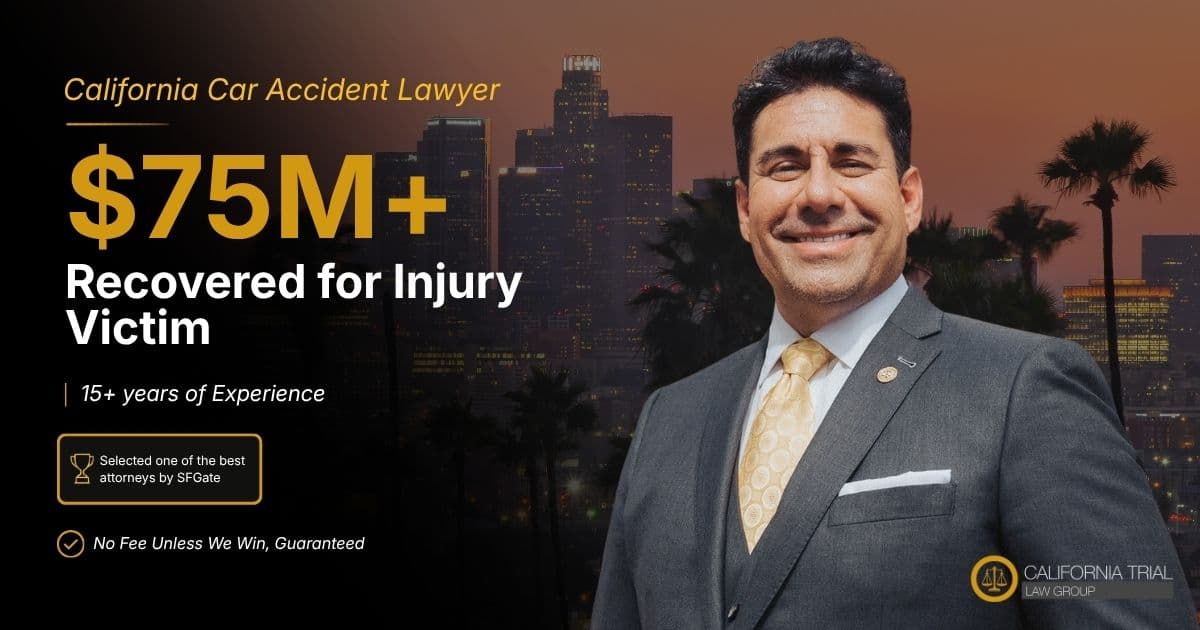
At California Trial Law Group, lead attorney Ike M. Kaludi (California State Bar No. 289576) has recovered over $29 million in a motor vehicle accident case and tens of millions more for injured Californians, without charging a dollar upfront.
Call (888) 238-7562 to tell us what happened, or schedule a free case evaluation, and we will tell you exactly where your case stands.

Following a crash, a California car accident lawyer handles four core tasks: investigation, valuation, negotiation, and litigation. Each task follows a specific process, whether your crash involved one other driver or several vehicles.
Investigation begins the moment you call us. We review the police report, collect expert witness statements, request traffic camera and dashcam footage, and pull your medical records to document your injuries. Evidence disappears quickly, skid marks fade, surveillance footage gets overwritten within days, and witnesses forget details the longer a case waits.
If the driver who hit you fled the scene, evidence collection becomes harder and moves faster. Our hit-and-run accident attorneys pull DMV records, canvass nearby businesses for camera footage, and coordinate with law enforcement to identify the driver before that evidence disappears.
If you have not yet documented the scene yourself, our guide on what to do after a car accident in California covers the steps that protect your claim in the first 24 hours.
Your claim includes two categories of damages: economic and non-economic. Economic damages cover costs you can calculate from bills and pay stubs. Non-economic damages cover harder-to-quantify losses like pain and the disruption to your daily life.
Insurance adjusters often rely on claims evaluation software, such as Colossus, to calculate initial offers that undervalue future medical costs and non-economic damages. We build your claim with input from your treating physicians and, in cases with lasting injury, a life care planner or vocational expert, so the number we present accounts for costs the adjuster’s software misses.
For a closer look at the evidence behind that approach, see how a California personal injury lawyer maximizes your compensation after an accident.
Insurance adjusters are trained to settle claims fast and low, often before your injuries fully surface. An early offer protects the insurance company's bottom line, not your recovery. We control the timeline, and we do not let an adjuster pressure you into a quick settlement before your treatment is complete.
Medical bills and health insurance liens are the biggest reason victims worry a lawsuit will not put money in their pocket. When your health insurer pays your medical bills after a crash, it holds the right to reimbursement from your settlement, known as subrogation. We negotiate that lien amount down before your settlement is finalized, the same way we negotiate outstanding balances owed directly to hospitals and providers. That negotiation is often the difference between a settlement that clears your debt and one that leaves money in your pocket.

Most car accident claims settle without a lawsuit. We file a lawsuit and prepare for trial when the insurance company's offer does not match the value of your claim, or when liability is disputed. Filing suit starts formal discovery: written questions, document requests, and depositions where each side questions witnesses under oath.
California follows a pure comparative negligence rule, so a jury can still award you compensation even if you share some fault for the crash. Your recovery is reduced by your percentage of fault, not eliminated by it. A driver found 20 percent at fault for a crash still recovers 80 percent of their damages. Most cases resolve through settlement once the insurer sees we are prepared to try the case in front of a jury.
No. We work on a contingency fee basis, meaning you pay nothing up front and owe zero attorney fees unless we win your case.
Our fee is a pre-agreed percentage that comes directly out of your final settlement or verdict. While some worry this percentage eats into their recovery, injury victims who hire an attorney recover roughly 3.5 times more on average than those who negotiate alone (IRC’s study on auto injury claims, 2014), even after the contingency fee is deducted. We build that advantage by documenting your full damages and negotiating your medical bills down before your settlement is finalized.
We review these numbers with you clearly before you sign anything, so you know exactly where you stand before moving forward.
In California, the timeline to protect your legal rights depends entirely on who caused the crash and what kind of damage you suffered. Missing these deadlines means you permanently lose your right to recover compensation.
Why you shouldn't wait: While two years sounds like a long time, insurance adjusters use early delays to argue that your injuries weren't actually caused by the crash. Investigating a crash, pulling traffic footage, and gathering medical records takes time.
California car accident laws are complex, and insurance adjusters know exactly how to use these deadlines against you. Protect your claim before time runs out. Schedule your free case evaluation today.
Call (888) 238-7562 to tell us what happened, or request a free case evaluation. We will respond within 24 hours. Bring your police report number, insurance information, and any medical records you already have, and we will tell you what your case is worth and what it will take to get there.
If you want a full list of questions to ask before you decide who represents you, our guide on what to ask a car accident lawyer in California covers what to bring to that first call.
We serve clients across California in English and Spanish, and every consultation is free under our Zero Legal Fee Guarantee.
Our attorneys handle car accident cases across California - bringing legal guidance directly to your community.
It depends on whether your injuries and losses go beyond what your own insurance already covers. A crash with no injuries and minor property damage often resolves without a lawyer. A crash involving any medical treatment, missed work, or a fault dispute benefits from legal review, and our free case evaluation costs nothing to find out which category your crash falls into.
Yes, you can still recover compensation. Insurance adjusters frequently assign you a fault percentage during the claims process itself, before any lawsuit is filed, and that percentage directly reduces the offer they present. We review the police report and evidence to challenge an inflated fault assessment before you accept a number based on it.
Yes, California law allows you to change attorneys at any point in your case. Your original attorney is entitled to payment for the work already completed, calculated as the reasonable value of that work rather than the full contingency percentage, and that amount typically comes out of your final settlement rather than your pocket directly.
You should get a lawyer first before you file an insurance claim after a vehicle collision. Getting a lawyer first prevents you from giving an accidental recorded statement to an insurance adjuster. A car accident lawyer manages the official insurance claim setup to protect your legal rights.
No, you should not accept the first settlement offer from an insurance adjuster. Accepting the first settlement offer waives your legal right to pursue additional financial recovery for latent injuries. Insurance adjusters utilize initial software calculations to issue low offers before your complete medical diagnostics are finished.

![[object Object]](/_next/image?url=%2F_next%2Fstatic%2Fmedia%2Fbadge-12.dc462899.png&w=1920&q=75)
![[object Object]](/_next/image?url=%2F_next%2Fstatic%2Fmedia%2Fbadge-1.84d39f5d.png&w=384&q=75)
![[object Object]](/_next/image?url=%2F_next%2Fstatic%2Fmedia%2Fbadge-3.30517db2.png&w=384&q=75)
![[object Object]](/_next/image?url=%2F_next%2Fstatic%2Fmedia%2Fbadge-4.c449d07d.png&w=384&q=75)
![[object Object]](/_next/image?url=%2F_next%2Fstatic%2Fmedia%2Fbadge-5.251e1420.png&w=1080&q=75)
![[object Object]](/_next/image?url=%2F_next%2Fstatic%2Fmedia%2Fbadge-6.e1d85cbc.png&w=384&q=75)
![[object Object]](/_next/image?url=%2F_next%2Fstatic%2Fmedia%2Fbadge-7.3fcf7c05.png&w=384&q=75)
![[object Object]](/_next/image?url=%2F_next%2Fstatic%2Fmedia%2Fbadge-8.3e662d12.png&w=384&q=75)
![[object Object]](/_next/image?url=%2F_next%2Fstatic%2Fmedia%2Fbadge-9.60ef0ba6.png&w=384&q=75)
![[object Object]](/_next/image?url=%2F_next%2Fstatic%2Fmedia%2Freputation-award.3f62935c.png&w=3840&q=75)
![[object Object]](/_next/image?url=%2F_next%2Fstatic%2Fmedia%2Fbadge-11.9de1d49a.png&w=1920&q=75)
![[object Object]](/_next/image?url=%2F_next%2Fstatic%2Fmedia%2Fbadge-13.de4d644c.png&w=640&q=75)