One moment you are driving home, and the next you are looking at a crumpled bumper, a police report number, and a call from an insurance adjuster who has already decided what your pain is worth. California recorded 4,061 traffic deaths in 2023, the latest finalized statewide crash data, according to the California Office of Traffic Safety (updated July 2025). The car accident lawsuit process moves through medical treatment, evidence gathering, a demand letter, and, if the insurer does not pay fairly, a filed lawsuit that ends in settlement or trial.
At California Trial Law Group, founding attorney Ike M. Kaludi and our California car accident lawyer team offer a free case evaluation within 24 hours, begin preserving evidence immediately before crash footage disappears, and build the medical and financial record a court needs.
The table below summarizes each stage of the process covered in this guide.
| Stage | What to Know |
|---|---|
| Right after the crash | Get medical care the same day, get the police report number, and file a DMV SR-1 within 10 days if damage exceeds $1,000. |
| Filing deadline | Two years from the crash date for a personal injury claim (Cal. Code Civ. Proc. §335.1); six months to claim against a government entity (Cal. Gov. Code §911.2). |
| Liable parties | The at-fault driver, the vehicle's owner, an employer, a government entity, or multiple defendants in a multi-vehicle crash can each answer for a crash, depending on the facts.). |
| Before a lawsuit | Medical documentation, an investigation, and a demand letter to the insurer resolve most claims without going to court. |
| Filing suit | A complaint, service of process, a 30-day answer, and discovery begin once negotiation fails. |
| If it goes to trial | California's pure comparative negligence rule still lets you recover, reduced by your percentage of fault. |
A California car accident starts the clock on a set of deadlines before any lawsuit exists. Medical treatment documents your injuries, a police report establishes an official record, and the state requires certain accidents to be reported directly to the DMV. Here is a quick summary of what to do after a car accident in California:
Avoid admitting fault at the scene. A reflexive apology or a guess about what happened can be used against you later, even when the crash was not your fault.

California gives most car accident victims two years from the date of the crash to file a personal injury lawsuit. The deadline changes by claim type and by defendant, and missing any of these windows ends the right to recover before a case is heard.
| Claim Type | Deadline | Governing Law |
|---|---|---|
| Personal injury (driver, passenger, pedestrian, cyclist) | 2 years from the date of the crash | Cal. Code Civ. Proc. §335.1 |
| Property damage only | 3 years from the date of the crash | Cal. Code Civ. Proc. §338 |
| Claim against a government entity or employee | 6 months to present an administrative claim. | Cal. Gov. Code §911.2 |
| Uninsured motorist claim against your own insurer | 2 years to demand arbitration or file suit | Cal. Ins. Code §11580.2(i)(1)(C) |
A crash involving a city vehicle, a public bus, or a pothole on a state highway carries the six-month government claim window described above. These deadlines apply whether or not the crash caused a physical injury, and a property-damage-only claim still qualifies for a lawsuit under the three-year window above, separate from the personal injury track. A California personal injury lawyer confirms which deadline applies before it becomes the reason a valid claim gets dismissed, and identifying whether a government entity is involved changes who the claim needs to name as a defendant.
A car accident lawsuit can name the at-fault driver, the vehicle's owner, an employer, or a government entity, depending on who caused the crash and why.
Identifying every liable party early shapes how your attorney builds the claim from day one.
More than one party may owe you compensation, and most people miss at least one. Reach out to us at (888) 238-7562, and our team identifies every liable party in your crash before the statute of limitations narrows your options.
Your claim is built long before a lawsuit is filed, through medical documentation, an investigation, and a demand letter sent to the insurer.
A settlement that far exceeded what she expected.
“I cannot speak highly enough of the exceptional service provided by the California Trial Law Group. From the moment I walked through their doors, I knew I was in good hands. My case was complex and emotionally taxing, but the team at this firm approached it with professionalism, expertise, and compassion. They guided me through every step of the legal process, ensuring I understood my rights and options clearly. It was through their attention to detail, dedication, and great communication that made me feel like I was a vital member of their team. Thanks to their diligent efforts, we were able to reach a favorable settlement that far exceeded my expectations. I am immensely grateful for the tireless work of the entire team: Tom, Jean, Leo, Paloma, Camilo, Mayra. I want to give a special recognition for my lawyer Ike Kaludi who went above and beyond in representing me through his unparalleled knowledge of the law and negotiation skills. If you're in need of legal assistance, I wholeheartedly recommend California Trial Law Group. Their commitment to achieving justice for their clients is incredible. Thank you for everything!"
— Trinidad Alcala-Arcos · Google Review
A car accident lawsuit begins when your attorney files a complaint in California Superior Court, after settlement talks with the insurer fail to produce a fair offer.
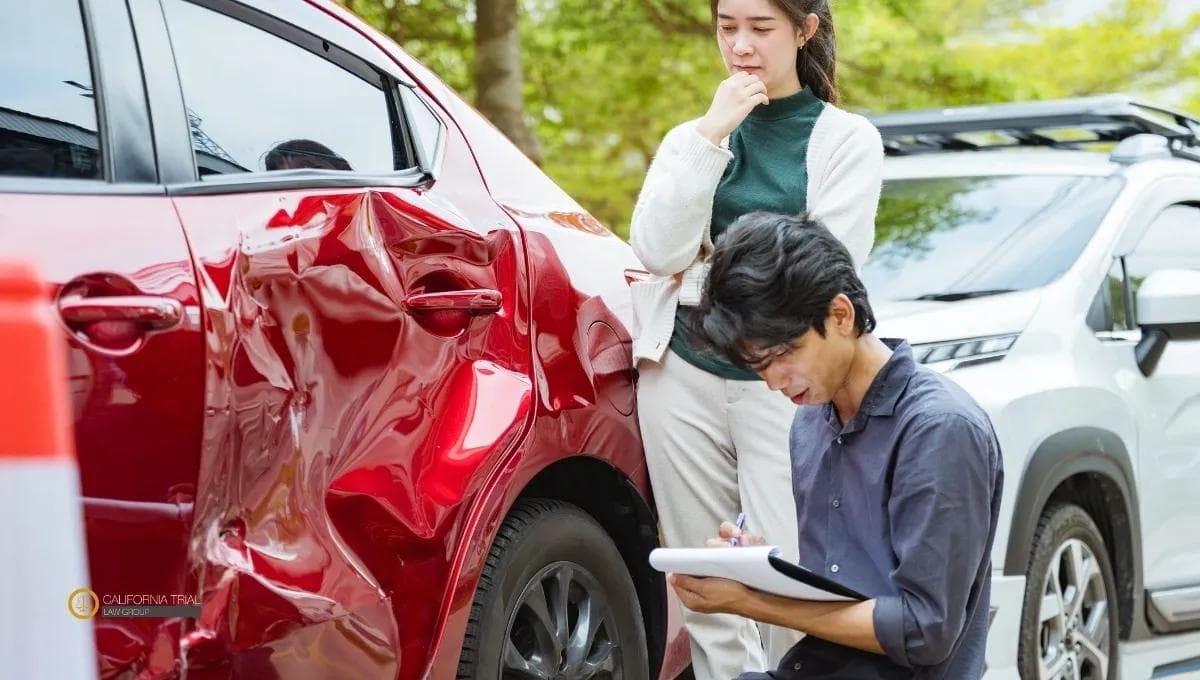
Most California car accident cases resolve before trial, through a negotiated settlement or a result reached in mediation. A case proceeds to trial when the insurer refuses a fair settlement and mediation does not close the gap between the parties. Jury trials in busier California counties can take 18 months or longer to begin after a case is filed, a scheduling reality separate from how long the trial itself lasts. At trial, a judge or jury hears the evidence, decides who caused the crash, and sets the compensation owed. A verdict can be appealed if either side identifies a legal error in how the trial was conducted, adding months or years before the case reaches a final result.
California's pure comparative negligence rule lets you recover compensation even when you share some fault for the crash. A jury or insurer reduces your award by your percentage of fault rather than barring recovery outright, no matter how large that percentage is.
| Your Percentage of Fault | Total Damages | Amount You Recover |
|---|---|---|
| 0% | $100,000 | $100,000 |
| 20% | $100,000 | $80,000 |
| 30% | $100,000 | $70,000 |
| 50% | $100,000 | $50,000 |
| 75% | $100,000 | $25,000 |
The table above reflects California's pure comparative negligence rule, which applies at every stage of the process, from the first insurance offer through a jury verdict. Even a driver found mostly at fault keeps a share of the recovery, a rule some states do not follow.
Compensation in a car accident claim covers medical bills, lost wages, property damage, and pain and suffering, and the total value depends on how well each item is documented through the process described above.
If an insurer is already shifting blame onto you, the percentage they assign changes what your claim is worth in real dollars.
Contact us at (888) 238-7562 for a free case review, and our team calculates what your fault percentage actually means for your recovery before you accept any offer.
You do not have to map out the entire lawsuit process before you call.
Call us at (888) 238-7562 or send your details through our contact form for a free, no-obligation case review.
Founding attorney Ike M. Kaludi and the California Trial Law Group legal team have recovered more than $57 million for California clients since 2024, including a $29.7 million verdict in a single case. Skilled Negotiators and Aggressive Litigators, we'll explain where your case stands, what the timeline looks like next, how to access car accident resources, and how our Zero Fee Guarantee protects you along the way.
Attorney Advertising. Results may vary. 100s Of Cases Won refers to favorable outcomes in settlements, trials, or arbitration.
Prior results do not guarantee a similar outcome. Case results depend on the specific facts and legal claims of each matter.
No, you do not have to go to court for most California car accident claims. Most disputes resolve through negotiation or mediation before reaching trial. Property damage disputes up to $12,500 can bypass a full civil suit through small claims court, which does not require an attorney
Yes, a passenger can file their own claim after a California car accident, against either driver involved in the crash. Passengers carry no fault for the crash, so comparative negligence rarely reduces their recovery.
If you were a pedestrian or cyclist hit by a car in California, the same two-year filing deadline and comparative negligence rules apply as they do to drivers. You can file a claim against the driver, or against a government entity when a dangerous road condition contributed to the crash.
If the at-fault driver has no insurance, an uninsured motorist claim through your own policy pays for your injuries instead. If that driver has insurance but not enough to cover your damages, underinsured motorist coverage closes the gap under California Insurance Code §11580.2.
If the other driver fled the scene, an uninsured motorist claim through your own policy still lets you recover compensation once law enforcement documents that vehicle-to-vehicle contact occurred, even without identifying the driver who fled. We've represented clients through this exact situation, including a rideshare driver who was rear-ended and hit-and-run injured while working, whose case moved forward under UM coverage even though the at-fault driver was never located.
No, you cannot sue in most cases once you have settled and signed a release with the insurance company, even if new injuries surface later. Review any settlement offer with an attorney before signing to avoid losing this right.
If the insurance company denies your claim, you can gather more evidence, request a written explanation under California's Fair Claims Settlement Practices Regulations, or file suit against the at-fault driver directly. An uninsured or underinsured motorist claim proceeds independently of that denial.
If you lose a car accident lawsuit, you recover no compensation for that claim. An appeal requires a specific legal error in the trial, not disagreement with the verdict. Contingency fee agreements waive attorney fees on a loss, though case costs may still apply.
A California car accident lawsuit takes 3 to 12 months when it settles without litigation, or 18 months to 3 years when it proceeds to trial. The timeline is driven by how quickly liability is established and how congested the assigned county's civil calendar is.
Hiring California Trial Law Group costs nothing upfront. We work under a Zero Fee Guarantee, meaning no fee unless we win your case. Attorney fees come only from money recovered, and if there's no recovery, you owe nothing for our time.