San Francisco Brain Injury Attorney
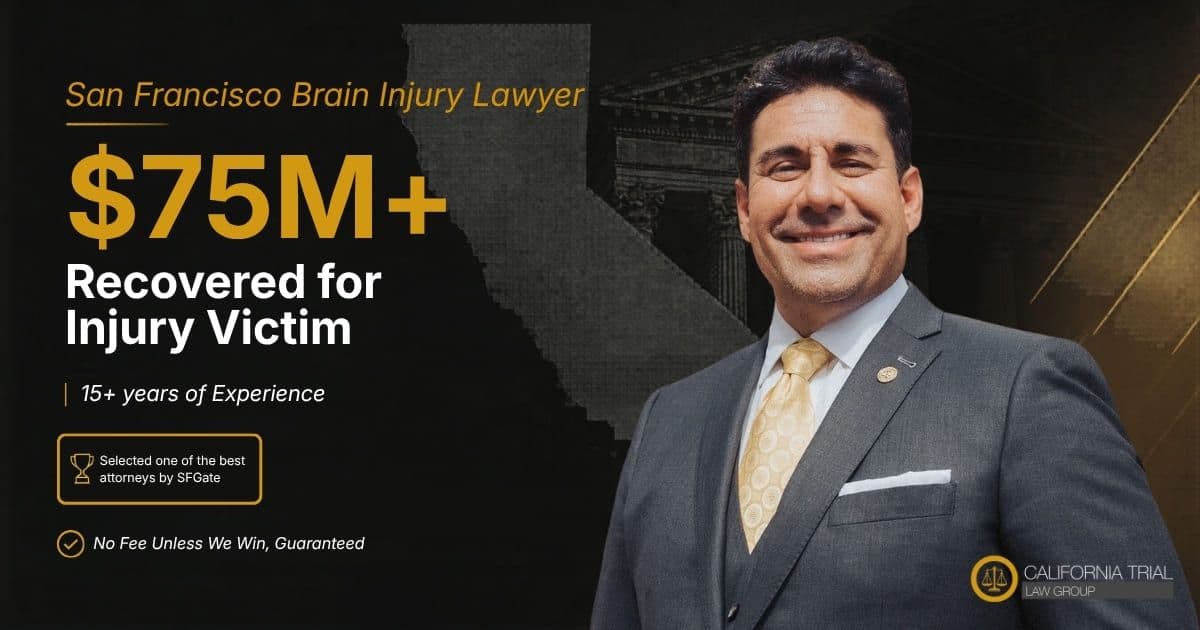
Over $30 Million Won for California Clients in 2025 Alone
![[object Object]](/_next/image?url=%2F_next%2Fstatic%2Fmedia%2Fbadge-12.dc462899.png&w=1920&q=75)
![[object Object]](/_next/image?url=%2F_next%2Fstatic%2Fmedia%2Fbadge-1.84d39f5d.png&w=384&q=75)
![[object Object]](/_next/image?url=%2F_next%2Fstatic%2Fmedia%2Fbadge-2.736d1614.png&w=384&q=75)
![[object Object]](/_next/image?url=%2F_next%2Fstatic%2Fmedia%2Fbadge-3.30517db2.png&w=384&q=75)
![[object Object]](/_next/image?url=%2F_next%2Fstatic%2Fmedia%2Fbadge-4.c449d07d.png&w=384&q=75)
![[object Object]](/_next/image?url=%2F_next%2Fstatic%2Fmedia%2Fbadge-5.251e1420.png&w=1080&q=75)
![[object Object]](/_next/image?url=%2F_next%2Fstatic%2Fmedia%2Fbadge-6.e1d85cbc.png&w=384&q=75)
![[object Object]](/_next/image?url=%2F_next%2Fstatic%2Fmedia%2Fbadge-7.3fcf7c05.png&w=384&q=75)
![[object Object]](/_next/image?url=%2F_next%2Fstatic%2Fmedia%2Fbadge-8.3e662d12.png&w=384&q=75)
![[object Object]](/_next/image?url=%2F_next%2Fstatic%2Fmedia%2Fbadge-9.60ef0ba6.png&w=384&q=75)
![[object Object]](/_next/image?url=%2F_next%2Fstatic%2Fmedia%2Freputation-award.3f62935c.png&w=3840&q=75)
California Trial Law Group provides trial-focused personal injury representation for clients in San Francisco, California, and throughout the Bay Area. Our brain injury services include: traumatic brain injury (TBI) claims, concussion and post-concussion syndrome cases, catastrophic injury litigation, wrongful death claims, and insurance claim disputes. Our San Francisco brain injury attorney serves all types of injury victims, from pedestrians injured in crosswalks to construction workers injured on-site to passengers involved in major transit collisions
A brain injury is often a silent crisis. Following a high-impact collision on 19th Avenue or a fall at a SOMA (“South of Market”) neighborhood construction site, victims may look fine on the outside with a “normal” CT or MRI scan. But struggle internally with persistent headaches, sudden mood swings, memory lapses, and an inability to perform high-level work.
Standard ER scans, designed to find life-threatening bleeds, may miss the microscopic axonal shearing common in concussions and diffuse axonal injuries. In San Francisco and across the Bay Area, insurance companies often dismiss these "invisible" symptoms as exaggerated. We focus on bridging this gap by building medical-evidence-first claims that document functional change in the real world, not just relying on police reports.
Whether your injury resulted from a Muni or BART accident, an Uber, Lyft, Waymo, or other rideshare crash, or premises liability, our priority is securing resources for your long-term recovery.
Attorney Advertisement: California Trial Law Group | 828 San Pablo Ave., Suite 109, Albany, CA 94706 | Ike M. Kaludi, Active License in California
While these past results reflect our experience with complex neurological injuries, please note that past results do not guarantee, warrant, or predict a future outcome in a specific case.
Why Hire Our Team for a San Francisco Brain Injury and TBI Claim?
Hiring a San Francisco brain injury lawyer from California Trial Law Group means securing an advocate who understands that a clear scan is just the beginning of the legal battle. While insurers rely on initial emergency notes from Zuckerberg San Francisco General Hospital and Trauma Center (ZSFG) to downplay harm as “low-impact” or that symptoms are malingering, we focus on the long-term neurological impact and replace those narratives with evidence.
Our approach to TBI litigation in the Bay Area includes:
- Medical-Causation-First Strategy: We coordinate with specialized neurologists and neuropsychologists to bridge the gap between initial ER scans and the reality of functional deficits.
- Trial-Ready Evidence Building: We structure the case around liability, causation, and damages for settlement leverage and litigation readiness, not an adjuster checklist.
- Strategic Pre-Existing Condition Defense: We use objective longitudinal testing, detailed treatment timelines, and “before-and-after” collateral witnesses to neutralize defense attempts to blame your symptoms on history.
- Functional Change Documentation: Our team goes beyond medical charts to document how the injury impacts career path, daily activities, work limits, cognitive endurance, and mood/behavior changes.
- Local Litigation Posture: By preparing every case for the specific nuances of the San Francisco Superior Court, we force insurers to take “invisible” injuries seriously.
- Comprehensive Damage Valuation: We work with life-care planners to ensure the injury claim accounts for decades of specialized therapy, lost earning capacity, and cognitive support.
- Clear, Stress-Free Communication: We handle the aggressive tactics of insurance investigators so clients can focus entirely on their medical recovery.
- Contingency Fee Representation: There are no upfront attorney fees, and we are only paid if there is a recovery. A formal written agreement will govern all specific fees and costs.
Types and Severity of Brain Injuries
In a legal context, medical labels are more than just diagnoses. They are the blueprints for proving causation, justifying future treatment, and calculating damages. One objective reference point clinicians commonly use is the Glasgow Coma Scale (GCS), which helps classify severity and keeps the claim aligned with the medical record.
Below are common brain injury types, grouped by how severity is often documented in medical records:
Traumatic Brain Injury (TBI)
A traumatic brain injury (TBI) is brain dysfunction caused by an external force to the head or body (for example, a blow, fall, or violent shaking). Severity is often framed using GCS ranges:
- Mild TBI (GCS 13-15): Often termed “concussion,” a mild TBI can look minor on paper while the person struggles with headaches, brain fog, memory lapses, sleep disruption, or mood changes. Because insurers often minimize these injuries, we document persistent symptoms and functional change to show that a high GCS score does not rule out lasting workplace or cognitive limitations.
- Moderate TBI (GCS 9-12): Usually involves a loss of consciousness (30 minutes to 24 hours). Moderate TBIs may cause obvious confusion, slowed processing, balance issues, or trouble returning to work or school. Documentation is vital here to secure funding for intensive speech and occupational therapies required to regain independence.
- Severe TBI (GCS 3-8): Marked by a prolonged coma or unconsciousness. Severe TBI claims are commonly associated with major functional impairment and require comprehensive life care plans to account for 24/7 medical supervision and profound changes to life expectancy and quality.
Diffuse Axonal Injury (DAI)
Diffuse Axonal Injury (DAI) occurs when rapid acceleration or deceleration causes the brain to shift, shearing the delicate nerve fibers (axons). This is common in high-speed collisions or violent whiplash-type events. Damage can be microscopic and often missed on initial CT or conventional MRI. Proof in DAI cases relies on the patient’s consistent neurological deficits and a treatment timeline. When clinically appropriate, we coordinate with specialists for advanced imaging (such as Diffusion Tensor Imaging (DTI) or Susceptibility-Weighted Imaging (SWI) to help corroborate internal injuries that standard hospital scans often miss.
Acquired Brain Injury (ABI)
An Acquired Brain Injury (ABI) is any brain injury occurring after birth. Unlike a traumatic brain injury, ABI often refers to non-traumatic causes, like anoxia (complete oxygen loss) or hypoxia (reduced oxygen), that can result from near-drowning, toxic exposure, stroke/cardiac events, or medical errors during surgery or treatment. Since liability can involve various entities (providers, facilities, employers), our strategy targets negligence in premises liability or medical malpractice to hold the responsible parties accountable for the internal trauma.

Common Causes of Traumatic Brain Injury in San Francisco
San Francisco’s unique infrastructure, from dense traffic and heavy transit use to constant construction zones, presents specific risks for catastrophic head injuries. Liability usually requires establishing that a breach of the duty of care directly caused the neurological harm.
Here’s what frequently causes TBIs in the Bay Area, and the specific evidence we prioritize:
| Cause/Accident | Local Risk Factors | Liability Evidence We Collect |
|---|---|---|
| Vehicle Collisions | High-speed crashes on major corridors like (e.g., 19th Ave, 101/280 approaches). Includes car crashes, truck collisions, motorcycle wrecks, and rideshare incidents. | Dashcam video, EDR/black-box data, crash photos, vehicle damage documentation, 911/dispatch records, witness statements, phone-use evidence when applicable |
| Public Transit (Muni/BART/Station Areas) | Sudden stops, platform/stair incidents, bus/rail crowd movement, station hazards | Operator reports, onboard/station surveillance, incident logs, maintenance/inspection records, training/policy materials, and witness identifiers before they disperseOperator reports, onboard/station surveillance, incident logs, maintenance/inspection records, training/policy materials, and witness identifiers before they disperse |
| Bicycle & Pedestrian Crashes | Doorings, right-hooks, crosswalk impacts, turning conflicts, delivery/commuter traffic | Signal timing and intersection data, nearby camera footage, driver statements consistency, bicycle damage/repair records, helmet analysis when relevant, scene measurements, and visibility conditions |
| Slip and Falls / Premises Liability | Slip, trip, and fall incidents in commercial spaces, uneven sidewalks/entryways, wet floors in hotels/venues, construction areas, and temporary walkways | Surveillance video, cleaning/inspection logs, hazard photos, incident reports, prior complaints, maintenance and code-history records, contractor scopes and safety plans, where applicable |
| Medical Malpractice | Errors in SF-based hospitals, such as surgical mistakes, or delayed stroke/cardiac diagnosis | Audit trails of electronic health records, anesthesia logs, and expert peer reviews |
Recognizing the Symptoms: Signs of a TBI You Should Not Ignore
Brain injury symptoms don’t always hit immediately. After a crash or fall, adrenaline can mask pain, and the first few hours may feel “fine” even as the brain is still reacting to trauma. While some symptoms appear instantly, others, such as cognitive brain fog or subtle behavioral shifts, may not surface for days or even weeks.
Red Flag Symptoms (Seek Urgent Medical Attention)
- Loss of consciousness (even if brief) or difficulty staying awake
- Severe or worsening headache
- Repeated vomiting or persistent nausea
- Vision changes or dilated pupil (one pupil appears larger than the other)
- Seizures or convulsions
- Slurred speech or inability to recognize people/places
- Increasing confusion, restlessness, or agitation
Safety Note: Avoid activities with a risk of further head impact until cleared by a doctor, as a second injury sustained before the first has healed can lead to more severe neurological complications.
Common “Invisible” Symptoms (Often undermined, still important to document)
Cognitive / Thinking
- Brain fog, slowed processing, trouble concentrating
- Short-term memory issues, losing words, difficulty multitasking
- Sensitivity to screens, light, or noise that disrupts focus
- Feeling mentally exhausted much faster than normal
Physical
- Headaches or pressure in the head
- Dizziness, balance problems, nausea
- Sleep disruption (sleeping too much, too little, or poor-quality sleep)
- Fatigue that doesn’t match your activity level
- Neck pain or stiffness (often overlaps with head trauma events)
Emotional / Behavioral
- Irritability, anxiety, depression, or mood swings
- Feeling “not like yourself,” flat affect, or sudden anger
- Increased sensitivity to stress or crowds
- Withdrawal from social activity or reduced motivation
This information is educational only and not medical advice. If you have symptoms after a head injury, consult a medical professional or seek urgent care for red-flag signs.

Building the Case: Documenting the “Invisible Injury”
Negative imaging results are the most common hook insurers use to deny neurological claims, yet these results rarely reflect the true extent of neurological damage. An experienced TBI lawyer’s job is to bridge the gap between initial hospital imaging and the actual daily struggles by turning subjective symptoms into objective, trial-ready proof.
Here’s a multi-layered evidentiary approach we use to document the injury:
| Diagnostic Tool | What It Documents | Why It Matters for a Claim |
|---|---|---|
| DTI (Diffusion Tensor Imaging) | Microscopic damage to white matter tracts and brain “wiring.” | Microscopic damage to white matter tracts and brain “wiring.” |
| SWI (Susceptibility Weighted) | Micro-bleeds and iron deposits (hemosiderin) from torn blood vessels. | Helps identify traumatic microbleeds and corroborate the traumatic force and symptom persistence. |
| Neuropsychological Testing | Objective deficits in memory, focus, and executive function. | Quantifies “invisible” harm for settlement valuation and jury clarity. |
| Collateral Witness Interviews | “Before vs. After” testimony from family, friends, and coworkers. | Humanizes the injury by proving a distinct change in personality and capability. |
| Digital Evidence | Dashcam, EDR, surveillance, incident reports, timestamps | Rebuts the defense claims that the impact was too minor to cause injury. |
| Medical Records + Treatment Timeline (Er, Follow-Ups, PT, Notes) | Symptom onset, progression, restrictions, response to care | Proves persistence and links symptoms to the incident |
We review your medical records and accident data to identify which advanced diagnostic options can substantiate your injury, even if your initial scans look “unremarkable.”
Compensation We Pursue for San Francisco TBI Victims
After a brain injury, the strain is rarely just medical; it is deeply financial and personal. While a legal claim cannot reverse the trauma, California law aims to “make the survivor whole” by addressing both tangible financial losses and the profound human impact on daily life.
As an expert San Francisco neurological injury lawyer, CTLG focuses on documenting present impact and future needs and pursuing every category of available compensation:
| Damage Category | Examples of What It Can Include | Proof We Use to Support Value |
|---|---|---|
| Economic Damages | ER and follow-up care, therapy/rehab, prescriptions, diagnostic testing, future medical care, home assistance, lost wages | Medical bills/receipts, treatment records, tax returns/pay stubs, employer verification, vocational analysis, life care planning support |
| Non-Economic Damages | Pain and suffering, cognitive impairment, emotional distress, sleep disruption, loss of enjoyment of life, and relationship strain | Symptom journals, neuropsych/psych reports, treating provider notes, family/coworker testimony, day-in-the-life documentation |
Valuing Loss of Earning Capacity
A TBI in San Francisco's competitive job market can be career-ending. When that happens, we may work with vocational experts to quantify the long-term income loss caused by a reduced ability to work. This valuation compares the victim's pre-injury career with their current cognitive and physical limitations, quantifying losses from reduced hours, inability to perform prior duties, or lost promotions.
Support for Families and Loss of Consortium
A head or brain damage rarely affects just one person. Family members are often forced into full-time caregiving roles, managing appointments, symptoms, and the household, while also coping with the victim's changes in personality and function. Loved ones lose companionship, affection, intimacy, and support due to the injury.
In California injury cases, a spouse or registered domestic partner may pursue loss of consortium damages for this type of loss. Compensation generally depends on the facts, the relationship, and credible documentation.
While our firm does not provide medical services, we can help coordinate and refer families to practical supports, such as:
- In-home care resources and care coordination referrals
- Conservatorship and capacity-related legal support when needed
- Special needs trust referrals to help protect eligibility and long-term planning
Deadlines for Brain Injury Lawsuits in California
In California, the time allowed to file a brain injury lawsuit is strictly governed by statutes of limitations.
- Standard Personal Injury: Claims against private individuals or companies must generally be filed within two years from the date of the injury.
- Government Entity Claims: If the injury involved a public entity (like Muni, BART, or the City and County of San Francisco), you must generally present a formal administrative claim within six months of the incident.
- Medical Malpractice: Claims against medical professionals must be brought within one year after the plaintiff discovers (or should have discovered) the injury, or three years from the date of injury, whichever is first.
Missing these deadlines will almost certainly bar recovery of compensation, regardless of the strength of the evidence or the severity of the trauma.
Although the statute of limitations may give you months or years to file, the “clock” for evidence is much shorter. Critical evidence, such as surveillance footage, dash cams from commercial vehicles, and digital maintenance records, is often erased within weeks. This requires a San Francisco brain injury attorney’s help to quickly preserve the evidence through spoliation letters.
Start With a Free Case Evaluation
A head or brain trauma can be scary, and the last thing an injured victim or family needs is more confusion. If you are considering a claim but don’t know where to start, talk to us. For legal clarity and support, CTLG reviews the situation and guides feasible next steps toward recovery.
Free, confidential consultation: Schedule online or call.
Free consultation starts with a confidential intake call. If your case has legal standing, an attorney will review your options. Submitting information does not create an attorney-client relationship.
ATTORNEY ADVERTISING: The information on this website is for general informational purposes only and does not constitute legal advice. California Trial Law Group does not form an attorney-client relationship through this website. The attorney listings on the site are attorney advertisements and should not be viewed as a referral or endorsement by any state agency or bar association. No certification as a specialist in any field of law is claimed by the lawyers listed here. Results from one case are not a guarantee of future outcomes, as each case has unique aspects. This website is intended to provide general information; it is up to you to decide if a particular attorney is suitable for your legal needs. You may be responsible for certain costs or expenses in addition to any contingency fee arrangement for attorney's fees. By using this site, you agree to our Terms and Conditions. This site is protected by reCAPTCHA and the Google Privacy Policy and Terms of Service apply.
The contents of this website and any attached or linked materials are intended solely for informational purposes and should not be taken as legal advice for any individual case or situation. Viewing this material does not create an attorney-client relationship. Choosing an attorney is a crucial decision and should not be based solely on advertisements. The outcome of your specific case will depend on its particular facts; previous results do not guarantee a similar outcome. Each case must be evaluated on its own merits. Reports of past cases on this website are not intended to generate unjustified expectations about any future case you might have.
California Trial Law Group is dedicated to defending the rights of the elderly in nursing home abuse cases. Our website offers general information and directs you to contact us for personalized legal advice tailored to the specifics of your situation. No attorney-client relationship is established by your use of this site or by any communication initiated through this website's contact forms. California Trial Law Group © 2026. All Rights Reserved.